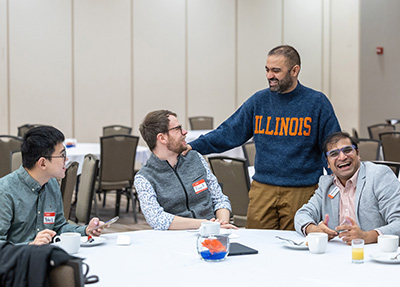
What does it take to build a supply chain that’s both profitable and sustainable? That question drew researchers, industry leaders, and students together for the Supply Chain Management Conference hosted by Gies College of Business at the University of Illinois on March 6-7 for two days of keynote addresses, research presentations, a panel of industry experts, and – new this year – a student case competition.
Now in its third year, the conference has taken on a new title – the Sustainable and Socially Responsible Supply Chains Conference. The new title reflects what organizers say has always been the mission of the conference.
“We’ve officially decided to rename the conference,” said Vanitha Virudachalam, assistant professor of business administration and one of the conference’s organizers. “The overall goals are similar. We’re continuing to look at ways to have sustainable, responsible supply chains. The world is rapidly changing, and we are looking forward to understanding how practitioners are responding.”
One of the year’s headline additions was a student case competition sponsored by Echo Global Logistics, which offered a case problem featuring real data. The competition was open university-wide, drawing in students not just from Gies Business but from The Grainger College of Engineering and other schools at the undergraduate, master’s, and PhD levels.
“We feel quite blessed to have a partner who’s offered real data and a real business problem for students to solve,” said Assistant Professor of Business Administration Hanu Tyagi. “The center of it is sustainability. This isn’t a simulation. Echo Global Logistics has this huge freight network, and they want to minimize carbon emissions without negatively impacting their profit. That’s really the kind of tangible business problem that our students get to work on – purpose-driven problems in industry. This is where rubber meets the road.”
From the Field
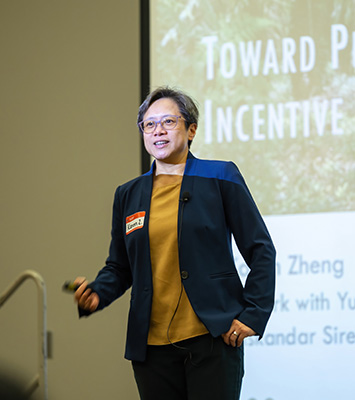
The conference featured two keynote addresses from leading voices in the field, alongside three research sessions spanning corporate strategy, social impact, and food systems. Pascal Van Hentenryck, director of the National Science Foundation’s AI Institute for Advances in Optimization (AI4OPT) and A. Russell Chandler III Chair at Georgia Tech, delivered a keynote address on artificial intelligence for engineering with applications in energy, supply chains, manufacturing, and more. Yanchong Zheng, George M. Bunker Associate Professor of Operations Management at the MIT Sloan School of Management, delivered a keynote on the second day of the conference exploring how incentive design and behavioral interventions can drive more sustainable outcomes in underserved agricultural supply chains.
The conference also featured research presentations across three sessions from a wide range of experts. In the opening session on corporate strategy, Sanjith Gopalakrishnan (McGill) proposed a hybrid carbon-footprinting method to better track scope 3 emissions through supply chains. Yifei Lu, assistant professor of accountancy at Gies Business, explored unexpected consequences of ESG transparency, finding that rating agency coverage can make managers less responsive to market signals. Finn Petersen (Indiana University) examined how vertical integration can reduce a firm's exposure to ESG violations. The second session on policy and social impact featured Luyi Gui (UC Irvine), who explored how AI's growing energy demands affect the renewable transition depending on market maturity, Dwaipayan Roy (University of Virginia), who investigated whether female legislators in India improve contraceptive uptake in government health facilities, and Bohan Li, PhD student in business administration at Gies Business, who proposed a recommender system designed to maximize the number of fully funded projects on donation-based crowdfunding platforms.
On the second day, the third session turned to resilient and sustainable food systems, with presentations on how drought ripples through U.S. food manufacturing supply chains (Sandy Dall'erba, Illinois), the unintended consequences of adding commercial partners to peer-to-peer food-sharing platforms (Kate Astashkina, University of Michigan), climate-adaptive harvest staffing strategies for specialty crop growers (Sanchita Das, PhD Student, University of Washington), and how manufacturers' discretionary sell-by dates can simultaneously increase food waste and reduce product availability (Aditya Vedantam, University of Buffalo).
Industry Voices
The conference attracted practitioners from Gies Business corporate partners Michael Ritter of Horizon Hobby and Jim Warfield of Caterpillar, as well as Morgan Zemaitis of ConAgra Brands and Helen Heiser of Abbott Laboratories, spanning industries from manufacturing and agriculture to consumer goods and healthcare, to share how their organizations are thinking about and navigating a shifting sustainability landscape. Assistant Professor of Business Administration Rakesh Allu, who moderated the industry panel, said he was pleased by the candid and informative tone the industry experts brought to the conference.
“We are most likely looking at a few years of sustainability policy getting turned on and off,” Allu said. “That uncertainty is ingrained into thinkers and managers, and we can share that with students. Now, sustainability as an idea is not set in stone. It’s going to become a political priority for some time and not at other times, and businesses have to respond. That fits directly into our framework. We teach that uncertainty in class, and this is a fantastic way for students to understand how uncertainty is actually dealt with.”
The panel surfaced two recurring themes from the audience: how firms respond to policy changes, and how sustainability teams drive outcomes without executive authority. On the first, representatives from larger firms were united in saying that their sustainability commitments exist despite shifts in policy, not because of them — rooted in a long-term vision and organizational identity that outlasts political cycles. Smaller firms, while less likely to have deeply embedded sustainability values, were noted to align with these standards when seeking to do business with larger customers who expect them.
On the second theme, panelists emphasized that titles carrying the word "sustainability" can be counterproductive, often triggering assumptions of being anti-business. Instead, the most effective approach has been to connect stakeholders around shared wins — illustrated by one panelist's example of organizing workshops for small and medium enterprises facing water scarcity, and another's use of sustainability research to support a marketing team's rebranding efforts.
Mili Mehrotra, Associate Professor of Business Administration and Academic Director of the Supply Chain Management major, noted two new additions to the conference's industry panel: Abbott Laboratories and ConAgra Brands, joining returning SCM corporate affiliates Horizon Hobby and Caterpillar.
“It’s so valuable to hear from partners across such different industries — from manufacturing at Horizon Hobby and Caterpillar, to food and consumer goods at ConAgra Brands, to healthcare at Abbott Laboratories. All of them are doing work in sustainability and corporate social responsibility that really applies to the theme of our conference,” said Mehrotra. “I think all of us benefit from hearing their grounded and practical perspective.”
Growing a Community
With AI, climate volatility, a shifting regulatory landscape, and global food insecurity all intersecting in the supply chain space, this year’s conference was a reminder that there are no easy answers – and no shortage of hard problems to work on. Gatherings like this are a space for scholars, practitioners, and the next generation of supply chain professionals to work through those problems together.
For Mehrotra, the goal of the conference is ultimately about what attendees take home.
“I want them to learn something beyond their regular curriculum,” she said. “How companies are making decisions, what’s happening in the supply chain field – learning from practitioners, learning from cutting-edge research. That would be really great.”
After three years, the Supply Chain Management conference is becoming more than a recurring gathering.
“The best part of this conference is the cross-pollination between industry and researchers,” said Virudachalam. “Now that this is our third time, we’re getting better at creating those connections – and it’s nice to see this community being built and growing.”