By Aaron Bennett
The Investment Management Academy (IMA), a program within the University of Illinois’ Gies College of Business, successfully completed the Fall 2025 semester with results that reflect both disciplined stock selection and a maturing investment process. From Aug. 26 to Dec. 12, 2025, IMA’s student-managed fund returned 5.66%, outperforming the S&P 600 by 2.06%. Risk-adjusted performance also held up well, with a Sharpe ratio of 1.17 and a Sortino ratio of 0.439 over the same period.
“Behind this success is a tremendous student team that stewards more than $1 million in University of Illinois Foundation assets,” said Rich Excell, clinical assistant professor of finance and co-director of the IMA. “These students handle all the responsibilities expected of analysts in a fund management environment, like conducting industry research, evaluating investment candidates, presenting investment recommendations, conducting due diligence, and more.”
IMA manages a $1.6 million long-only small-cap equity portfolio, typically runs a concentrated book of about 20 stocks, stays nearly fully invested with minimal cash, and avoids leverage, creating a clear test of research quality and decision-making.
Students drive results through professional-grade process
The Investment Management Academy’s structure is designed to turn learning into performance. The investment process is built on rigorous fundamental research and collaborative decision-making. Analysts work in pairs within sector-specific groups to screen for potential investments, conduct comprehensive financial analysis, and build three-statement models to support their recommendations. Each group is overseen by a portfolio manager who provides mentorship throughout the selection process. Recommendations are vetted through a director’s review and class voting to ensure alignment with the fund’s goals. It’s an end-to-end workflow that rewards both conviction and accountability.
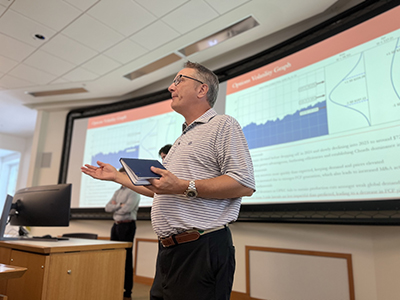
“That rigorous process was extremely important during a choppy 2025,” said Mike Vitek, clinical assistant professor of finance and co-director of the IMA. “Our students navigated a complicated environment that included slowing inflation, a Federal Reserve approaching rate cuts, and tariff uncertainty. That really elevated the importance of macro awareness – particularly around rate sensitivity, tariff exposure, and balance-sheet resilience – and directly shaped portfolio decisions.”
IMA’s leadership regularly assesses the strengths and weaknesses of the program and is always making adjustments in an effort to improve. Co-President Mark Gao attributes much of this semester’s outcomes to a deliberate push to professionalize the program. Over the past year, the Academy refined how students communicate their ideas; they made reports and presentations more clear and concise, with stronger emphasis on catalysts and the “variant view.”
Just as importantly, IMA rebuilt its internal structure around three defined verticals: Portfolio Management, Mentorship, and External – creating clearer ownership and a more efficient operating model.
“IMA has the greatest number of members it has ever had, and in my opinion, we’re operating at a higher level and across more dimensions than at any point in our history,” said Mark Gao, IMA co-president and a Gies Business senior majoring in finance and accountancy.
"Careers in securities analysis and portfolio management are highly competitive and highly sought after," said Excell, who combines with Vitek to bring more than 60 years of experience into the classroom. "IMA students put themselves in the best positions to compete for top jobs, and they're prepared to excel in those positions from day one."
That’s evident in the IMA’s 100% rate of successful outcomes, meaning every student either lands a job or pursues graduate education. First destination outcomes include some of the world’s top firms in private equity, investment banking, wealth management, consulting, and more. If you’re interested in meeting or recruiting our students, visit the Gies Business website.
State-of-the-art access and meaningful support
While the fund’s outperformance is a tangible proof point, IMA’s broader value is the pipeline it builds. Students graduate with repeated reps in the most in-demand skills like idea generation, modeling, debate, risk framing, and decision-making under uncertainty.
Much of the strength of the IMA lies in the infrastructure of support at Gies Business. Students have the opportunity to learn from some the world’s best faculty, many of whom bring decades of investment experience. They also have access to state-of-the-art facilities like the Margolis Market Information Lab, one of the most highly utilized university finance labs in the country. Opened in 2009, the lab provides exposure to real-time financial and alternative data as well as live coverage of financial news networks. Each workstation is equipped with cutting-edge hardware and software providing a unique hands-on experience for students. The College also recently received a nearly $5 million in-kind gift from Morningstar, Inc. that provides students with professional grade access to Morningstar Direct,
“The Margolis Market Information Lab has continued to be a home base for our members,” said Gao. “It’s rare to walk in and not see students collaborating, studying, or discussing markets. That culture matters because it reinforces the idea that investing is something that extends beyond meetings and becomes a daily habit.”
As we look ahead, I’m more optimistic than ever about how we’re positioned for long-term success,” said Excell. “Our excellent pipeline of students combined with our commitment to thorough analysis and collaborative decision-making keeps the fund positioned to continue pursuing its goal of beating the S&P 600.”