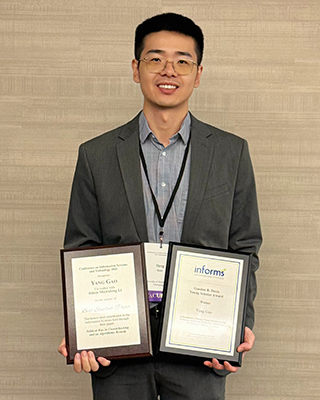
Yang Gao, assistant professor of business administration at Gies College of Business, has been named a recipient of the INFORMS Information Systems Society’s (ISS) Gordon B. Davis Young Scholar Award.
ISS announced the award on November 1 at the Conference on Information Systems and Technology (CIST) in San Francisco. The award is named in honor of University of Minnesota professor Gordon B. Davis and recognizes and honors young scholars who are on the path towards making significant intellectual contributions to the information systems discipline.
“We believe Gao has established one of the most distinctive early-career research trajectories in information systems,” noted his nominators. “By bringing together platform governance, artificial intelligence (AI), rigorous empirical methods, and algorithm design, he has established a research identity that is both intellectually distinctive and highly relevant to the future of our field.”
In addition to the Young Scholar Award, Gao was named a winner of the CIST 2026 Best Student Paper Award for “Political Bias in Crowdchecking and an Algorithmic Remedy," which recognizes both Gao and Adam Shenxiong Li, a PhD student at the University of Rochester’s Simon Business School.
Gao’s research uses causal inference and applied machine learning to examine how digital technologies shape information, platforms, and customer interactions, with a focus on social media, misinformation, artificial intelligence, and customer service.
For instance, his 2025 paper, “Does Social Bot Help Socialize? Evidence from a Microblogging Platform," found that users on Weibo reacted favorably to posts that received comments from CommentRobot, a platform-owned social bot similar to Grok on X.
Along this research stream, his 2026 paper, “When Influencers Delegate Replies: How Social AI Agents Shape User Engagement,” examined how users react when influencers delegate reply tasks to their social AI agents. The study found that users who received responses from the social AI agent became more likely to engage with the influencer in subsequent interactions. Gao continues to expand this research stream on human-AI interactions on social media, with ongoing projects investigating how relationships between users and social bots evolve and how AI-powered auto-dubbing of YouTube videos across languages influences audience engagement.
In another research stream, Gao examines how social media platforms can combat misinformation through crowdsourced fact-checking (crowdchecking) systems. In his paper, “Can Crowdchecking Curb Misinformation? Evidence from Community Notes,” he discovered that crowdchecking systems, such as Community Notes on X, can effectively curb misinformation at the source level, as users are more likely to retract their false or misleading tweets when community-approved corrections (i.e., community notes) are added underneath their tweets. However, crowdchecking systems are not without limitations. Gao is investigating how racial and political biases among contributors can influence crowdchecking outcomes and how improved algorithmic design, including the integration of AI, can help make these systems fairer and more effective.
“I am deeply honored to receive the ISS Gordon B. Davis Young Scholar Award,” Gao said. “This recognition reflects not only my work, but also the generosity and support of the many mentors, collaborators, students, and colleagues who have helped me grow as a scholar.”
Gao is the editor of the INFORMS ISS Newsletter and an associate editor of the Decision Sciences Journal. He has been named a Gies Advanced Study Scholar and has been named to the List of Teachers Ranked as Excellent three times.
Gao earned a PhD in information systems from the Simon Business School at the University of Rochester in 2021. After a two-year stint as an assistant professor of information systems at Singapore Management University, Gao joined the Gies Business faculty in 2023.