By John Turner
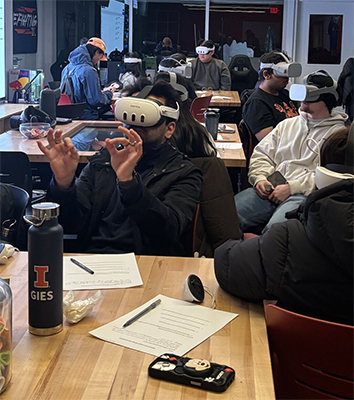
Earlier this semester, 30 students from Gies College of Business traveled to the Za’atari refugee camp in Jordan, where they watched kids playing soccer, observed a traditional Syrian meal, and listened to a young girl share her experience of life in the camp. Or … at least, it felt like they did.
In reality, the students were sitting at the Innovation Studio at the University of Illinois’ Center for Innovation in Teaching & Learning, taking part in a virtual reality experience designed to help them develop a better sense of empathy. Those students – mostly upperclassmen in accounting, finance, business, and other related studies – will soon be entering a business world where artificial intelligence is playing an increasingly larger role. So why do they need to cultivate empathy? According to Vidya Haran, teaching associate professor of business administration at Gies Business, the answer is simple: empathy is everything.
“It’s the foundation of problem-solving,” said Haran, who also serves as academic director of information systems major. “Whether you’re in accounting or finance, you need to be able to empathize and see what users are feeling so you can build a solution around it.”
That’s why she partnered with Rachel Switzky, director of the Siebel Center for Design, to incorporate empathy into the first human-centered design course at Gies Business. Haran’s course, BADM 371: User Interaction/User Experience Design, provides a project-based introduction to the user-experience design process, which goes far beyond things like colors and tactile choices.
“In user experience design,” said Haran, “we want to design the entire experience.”
That means understanding all the pain points a potential user might encounter, using field interviews, journey mapping, and other tools to uncover critical issues early in the design stage. It’s a process that requires a great deal of empathy. And showing “Clouds over Sidra” an award-winning short film about the Syrian refugee crisis, is one way to help students cultivate that skill in a very intentional way.
The VR experience offers a 360-degree field of view and immersive sound that lets viewers stand in the room of a young Syrian girl as she shares her story and hear the rush of the desert wind. And for Caitlyn Li, a senior studying accounting and information systems, that sensory experience conveyed so much more than any facts she could have absorbed from a textbook.
“It was very emotional,” said Li, who felt the rest of the class fade away as she stepped into world where it seemed like the story’s narrator, a 12-year-old Syrian girl, was talking directly to her. “It was like a one-on-one conversation. That really stuck with me.”
Li, who plans to go into consulting, says empathy will be important in her future line of work. “I feel like being able to understand your clients, what they need, and why you’re doing what you’re doing is really important.”
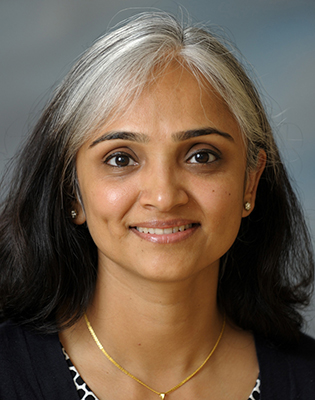
Providing a sense of “human-ness” in design could become even more critical going forward, as the line between reality and AI continues to blur. Haran (left) got a sense of that last summer when she partnered with the Siebel Center for Design to help an AI company adapt a technical product for non-technical users.
“We worked with them to make the whole process of interacting with this generative AI platform less intimidating, more trusting, and more user friendly,” said Haran. “It had very little to do with computer science or algorithms or coding. It was all rooted in empathy.”
That’s why empathy is at the heart of her 300-level course, as well as BADM 590, a graduate-level course on the same topic. Over the years, she says she’s had requests to expand her class to include students from other colleges and schools on campus. Haran says it’s hard to say no, but she feels that is important to keep the class size small. And that formula seems to be working, with many students demonstrating a greater sense of empathy after taking part in the VR experience.
Some said they could feel the pain of refugees who cannot return to their homeland. Others said that it gave them a better understanding of conditions in the camp. One wrote, “it moved me from understanding someone else’s feelings to actively trying to experience someone else’s reality and listening without judgment.”
When it comes to teaching empathy, you can’t get much better than that.