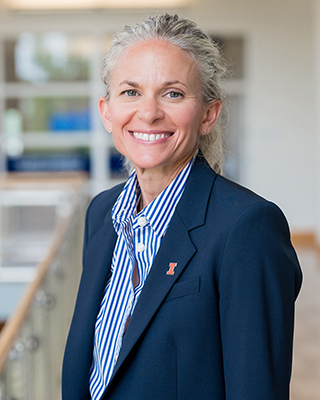
Gies College of Business Dean Brooke Elliott (right) and Nebraska Dean Kathy Farrell agree that AI's disruption is less about the tools themselves than about what they're forcing institutions to confront.
"A lot of times you ask business school deans what keeps them up at night,” Farrell said. “It’s AI.”
“It definitely changes the tools that students have available," Elliott said, noting that Gies has been adapting to AI-driven change for years because of its large-scale online programs, which pushed the College to rethink quality at scale well before generative AI became ubiquitous.
Both deans made these comments during a recent conversation moderated by Nerissa Brown, executive associate dean of academic programs and H.T. Scovill Professor of Accountancy at Gies Business. The discussion, framed around how business schools should evolve over the next decade, ranged from AI's effect on classroom pedagogy to its murkier implications for academic research, energy costs, and equity.
The head start that Elliott described hasn't eliminated the anxiety, though. She described a tension between AI's speed and the slow institutional machinery of curriculum design.
"Our curriculum processes are very long when it comes to getting a new course approved," she said. "By the time we invested in creating a new course and got it through the approval process, the course would be stale by the time we were ready to deliver it."
Across Gies Business, artificial intelligence is reshaping how students develop the skills that matter most in today's workplace. Faculty are integrating AI into courses through simulations, chatbots, immersive experiences, and hands-on projects that challenge students to ask better questions, evaluate AI-generated insights, and solve real business problems. More than simply teaching students how to use AI, Gies Business is preparing them to think critically, adapt confidently, and lead in organizations where people and AI increasingly work together.
Both deans returned repeatedly to what Elliott called "durable skills.” These include critical thinking, communication, and teamwork that increase in importance amid constant technological churn.
"It really comes back to putting the human in the center," Elliott said, even as AI reshapes how students learn and how faculty teach.

The conversation also surfaced concerns that go beyond the classroom. Farrell raised what she sees as an underexamined problem: the true cost of AI tools, particularly their energy demands.
"We're accessing a lot of the AI tools below what they actually cost to produce, especially from an energy perspective," Farrell (right) said, warning that once subsidized capacity runs out, the efficiency gains schools and businesses are counting on may not materialize. Elliott connected that concern to the physical landscape of the Midwest, noting the spread of data centers across former farmland and to a generational skepticism she's observed firsthand.
"We see it first" on college campuses, she said, citing reports of students booing AI references at commencement ceremonies – an early signal, in her view, of where public sentiment may be heading.
On research, both deans acknowledged uncertainty about how AI will reshape scholarship and doctoral training. Farrell questioned what happens to the slow, immersive process of literature review that has traditionally underpinned a PhD now that AI can summarize entire bodies of research in minutes. At the same time, she pointed to opportunities for business schools to lead on AI governance research, particularly around accountancy, finance, and the public-policy implications of AI-driven organizations.
The two deans also discussed how experiential learning – case competitions, live client projects, and study-abroad partnerships – has become central to meeting rising student expectations, with Elliott highlighting a recent 24-hour "AI build-a-thon" at Gies where students tackled real problems submitted by College staff.
The conversation underscored a central tension of the moment: business schools are being asked to prepare students for AI-driven transformation at precisely the time when that transformation is threatening to outpace their own ability to respond. Whether the answer is a new course, a new partnership, or a new way of thinking about what a degree is for, both Elliott and Farrell made clear that standing still isn't an option. The schools willing to move fastest will define what business education looks like for the next generation.