Leaders are under constant pressure to deliver: quarterly targets, product cycles, stable performance. The irony is that many of those closest to the work, like the people who answer phones, handle customer issues, or implement solutions in real time, don't experience their days as "stable" at all. Their days are a kind of improvisation act with consequences.
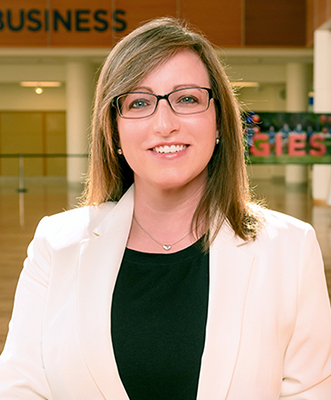
Elizabeth Luckman is a leadership educator, coach, and clinical associate professor of business administration at Gies College of Business. She helps organizations empower people and solve problems. In a new article, Luckman answers the question of why those frictions add up at work. Organizations exist to solve complex problems, but many employees feel constrained by the very systems meant to solve them. For Luckman, that tension comes from something fundamental.
"Our brains are constantly looking for predictability and trying to control what's going on around us in a world that is inherently uncontrollable," said Luckman. "I can tell you all the things I'm going to do to drive business, but I cannot control the outcome. Yet there is a tendency to want to make things conform to the way we want them."
In "Crafting Ethical Problem-Solving Cultures: A Leader's Role in Complex Adaptive Systems," Luckman argues that often the root issue of workplace frustration isn't a lack of vision or values statements, but rather the mental model leaders use to understand how their organizations work. If that mental model isn't a good fit, even well-intended leaders can produce ineffective (or unethical) outcomes.
From Machines to Living Systems
Many workplaces still operate like the organization is a machine – controllable and optimizable. That mechanistic mindset shows up everywhere: from rigid job descriptions to "command and control" hierarchies and cultures where failure is punished instead of being treated like information.
But work doesn't operate according to machine logic. Teams of people work interdependently, with rapidly changing information and contexts – problems no leader can see the full scope of. Luckman instead points leaders toward a different lens: seeing organizations as "complex adaptive systems" (CAS), defined by interdependence, feedback loops, and self-organization.
In a machine model, leaders control. In a complex-systems model, leaders create the conditions for effective problem-solving. That shift in thinking changes what leadership is.
“If you see a problem, I need you to tell me about that problem,” explained Luckman, who teaches courses in business dynamics and leadership for on-campus and online learners at Gies Business. “This is the core of psychological safety. You feel comfortable enough to say, ‘hey, we’ve got to stop the line, because if we spend the time and fix this now, it’s all going to be better. The 10 minutes we spend fixing this is going to be worth it down the line.' That’s a form of adaptability.”
Companies spend ample time and money focusing on developing great cultures. But culture, according to Luckman, isn't an item on a checklist, and it isn't something you can impose by force. It's a kind of emergent x-factor that arises from the right conditions.
"If you want to change the culture of your team, I am not promising you some kind of magic potion,” said Luckman. What I’m saying is that if you can engage differently, if you can show up differently, through that intentionality you can make better decisions. Then maybe someone from the outside looks, and it spreads."
Rather than imposing directives on leaders like "be ethical" or "care about your culture", Luckman sees ethical problem-solving as a mindset – a repeatable pattern of working and communicating. Making ethical decisions, it turns out, comes down to prioritizing well-being while creating adaptable and sustainable products and services.
She pairs that with a "culture of problem solvers,” people who are patient enough to define problems clearly, engaged with their teams, and committed to learning. That combination results in teams that:
- Identify root causes rather than symptoms
- Run experiments to close gaps
- Support ethical choices
Those behaviors, when applied like habits, create the conditions for great problem-solving. Leaders have to manage, but they also have to respond to a thousand little fires throughout a work week. That speed and urgency can quietly erode quality decision-making and ethical behavior. Short-term thinking distorts what organizations measure and value.
“This is one of the biggest challenges that everyone in my field faces – ‘I don’t have time for that because,” said Luckman. “We’re inside systems that reward us for specific things. Quarterly reports, for example, drive a lot of our economy. That means we operate on very short-term turnarounds. So everything is measured in terms of output, not process.”
When trust is low, teams pay a hidden tax: people spend time managing impressions and relationships. Instead of solving problems together, team spend time monitoring others and protecting oneself. Measuring isn't inherently bad, but what gets measured is what gets managed.
“You have to have trust,” said Luckman. “If we’re in a hurry to get things done and I know that everyone has to look out for themselves, that’s what I’m going to do. I’ve got to wiggle around, I’ve got to think, ‘how am I going to get them to do this?’ How am I going to follow up and make sure they’ve done it? Because I don’t have trust. All of a sudden, that’s taking time that we don’t need to be taking.”
Rules For Scaling Culture
If culture can't be forced, then what can leaders do? Luckman's research points to simple rules that leaders can employ to help teams navigate complexity without falling back on rigid ideas of control. In a complex adaptive system, habits like sharing information openly or seeking diverse perspectives create the conditions for decentralized problem-solving.
Luckman identifies three leadership priorities that enact those rules: safety, engagement, and growth.
Safety is foundational to good work. Luckman's example here are Pixar's "brain trust" meetings: structured, candid feedback sessions where power dynamics are deliberately kept to a minimum and teams go in expecting early ideas to be "dismantled and rebuilt." To be open to that takes safety – the belief that your voice matters, and that speaking up with concerns won't be met with humiliation.
Engagement is about designing work so that people can contribute meaningfully and tap into their internal motivations, not just give a stamp of approval or comply with orders.
“Research tells us that people need to be seen, heard, and valued to be engaged,” explained Luckman. “People need to know that there is a why to how they’re doing their work…the mindset of seeing the system that we’re in as complex gives us the space to navigate it with more grace.”
Growth means making learning central to how teams operate. That might mean embracing rapid experimentation, reflection, and adapting to change. Luckman highlights prototyping as a kind of learning, noting that teams often debate too long before testing an idea to see what happens.
The Human Case for Ethical Cultures
There's a classic dichotomy in management and leadership discourse. Advice typically chooses a lane between being systems-aware (and thus big-picture) and being personal (and thus empathetic). Luckman, however, sees past that false choice. Her research stays grounded in context, acknowledging that talk of "meaning" and "culture" can ring hollow for those in exploitative situations.
But for leaders with the power to set tone and shape workplaces, she makes an ethical case grounded in everyday experience.
“Life is short, and we have a limited amount of time here,” said Luckman. “Do you really want to be miserable with the people you work with every day? We can design things more intentionally.”
Ethical leaders see the big picture but ground themselves in practice. They show up with intention, dig deeper into problems, treat people with respect, and build environments where teams can learn and thrive. Ethical outcomes are shaped by the systems, incentives, and norms that those leaders set into motion. By moving away from thinking about their organizations as machines and toward recognizing them as complex adaptive systems, leaders can build cultures where people tackle problems early, collaborate smoothly, and learn faster. For anyone who has felt that work could be better, but wasn't sure to begin, Luckman's research offers a starting line: design the conditions by which ethical problem-solving comes naturally.