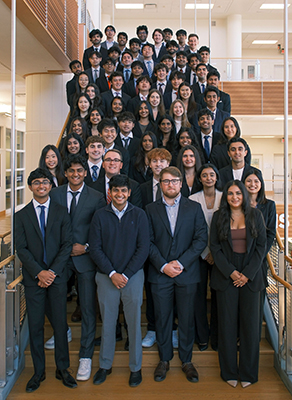
At the turn of the century, campus leadership recognized an opportunity to harness entrepreneurial spirit and transform world-class innovation into products and companies that deliver wide-ranging benefits. Over the past 25 years, several differentiating programs emerged that set Illinois apart from most institutions that aspire to become entrepreneurial engines. EntreCorps is one of those programs.
Housed in the Origin Ventures Office of Entrepreneurship in Gies College of Business, EntreCorps provides valuable consulting work at no charge for startups within the University of Illinois ecosystem. What makes the program unique is that those consultants are also Illinois students, many of whom are training for similar careers in the real world.
Each semester, as many as nine EntreCorps teams consult with startups to conduct market and/or customer research that helps shape the direction of the fledgling company. The teams include a project manager, a senior consultant, and four or five consultants. The projects are protected by non-disclosure agreements (NDAs), which provide the company assurance that their trade secrets will be held confidentially.
EntreCorps Executive Director Misha Gandhi was part of a business organization in high school and helped one of her friends market a startup.
“EntreCorps is open to all majors and grade levels,” Gandhi said, “We have student representation across all the different schools, such as Gies Business, Grainger College of Engineering, School of Information Sciences, Liberal Arts and Sciences, and much more. We try to accept more students who will be growing alongside the firm and taking on the next leadership cycle, so we accept anyone who has a passion for the organization and its culture. We have accepted freshmen and sophomores with little to no experience, but also master's students with a great amount of experience— we are open to all.”
“Students get hands-on consulting experience, which most haven’t had outside of class,” said Eunice Chang, EntreCorps’ director of engagement and a Gies Business senior majoring in accountancy and information systems.
Like every Gies Business senior, Chang has taken Business 301: Business in Action, one of the largest experiential learning courses in the nation. Students, typically in their junior year, work together in teams to analyze and solve business problems for Fortune 100 corporations, mid-sized and startup companies, and nonprofit organizations.
“Business 301 is a nice introduction for those who haven’t done consulting before, but EntreCorps provides them with a faster pace.”
Chang adds that EntreCorps members can benefit from answering clients’ questions, which strengthens their presentation skills.
“The startups are often so impressed with their work that they offer our students roles within their teams, while some are even inspired to create their own startups,” Chang said. “It has been fun to see students who worked with us come back as clients because they know the ins and outs of EntreCorps.”
Regardless of prior experience, EntreCorps provides training and a structure that helps its students grow. The director of training development oversees three training sessions each semester, one geared toward new consultants, one on primary research, and a firm-wide training, which reminds teams of best practices for presentation and deliverables. There are also more targeted sessions, like a recent one on human-centric design, which many of today’s startups are looking for.
Through experience and recommendations, students can earn their way up the leadership ladder within EntreCorps. An alum of the program encouraged Chang to get involved. A native of Oregon, Chang had previously helped Portland Gear, which sells Portland-inspired apparel and gear, with market research. She says that EntreCorps has expanded her experience to include tech and AI-based startups.
EntreCorps began as part of the Magelli Office of Experiential Learning at Gies Business, but transitioned under the umbrella of the Origin Ventures Office of Entrepreneurship in 2024. That move has, in part, enabled EntreCorps to work more closely with the iVenture Accelerator, a university-wide innovation development program that creates opportunities for student-led startups to turn ideas into scalable ventures.
“We have been able to see how iVenture fellowships work and are often onboarding those startups as EntreCorps clients through the pipeline,” Gandhi said. “They also have a partnership with other organizations.”
Startups are often connected to EntreCorps through the iVenture Accelerator or through Business 301 classes. The EntreCorps leadership team also reaches out to small businesses across campus to see if they have any potential projects.
“Once all the applications are collected, we do one-on-one interviews to see if they are a good fit,” Gandhi said. “Then we do a scoping call to ensure all the work streams and scopes are taking place.”
Once the startups are onboarded and signed, EntreCorps leadership gives a brief description to each project manager and senior consultant, who then rank them based on level of interest within the team.
“Usually, there is an even split, so everyone is assigned their first or second choice,” Gandhi said.
Once they are paired, consultants and clients hold an introductory call for in-depth scoping, and they lay out a week-by-week strategy. The two sides meet again for midpoint and final presentations as well.
“We tailor the research based on each startup’s needs,” Chang said. “For instance, we might conduct Beta testing if they have apps or websites that they want us to play around with. We might do primary research in the form of customer focus group surveys. We might interview professionals in other industries. A good bulk of it is secondary research.”
Most, but not all, teams are mid-level in terms of development and have an established website and/or social media presence.
“Although we try to be flexible in determining fit, we have found in general that if they have a passion, their project will be successful,” Gandhi said.
It’s also not unusual for teams to re-up with EntreCorps for a second or third semester of work.
“In those cases, the project scope will shift,” Chang said. “Our project director will go over the scoping shorts to make sure that there is something we can do that doesn’t conflict with the research they have already received.”
Startups like Elite have benefited from EntreCorps' expertise. Vidhi Chavda opened the business at Second and Green Street in Campustown to provide healthy food options with nutritional supplements for students going to and from class.
Working with Entrecorps has been amazing,” Chavda said. “The students on the project are invested in making progress like it's their own. They helped Elite create strategic solutions using research to back up their ideas. Even better, they created a step-by-step plan for Elite to execute. EntreCorps helped Elite grow from the inside and out, and we look forward to working with them in the future.”
“We don’t have an incubator where we directly build startups, but we welcome a lot of startups across campus to grow,” Gandhi concluded. “I look at EntreCorps itself as a startup because we are consistently growing and changing as ideas and technology evolve.”