Through the Disruption Lab at Gies College of Business, AI projects are no longer just ideas; they’re becoming reality. Across campus, faculty are exploring how emerging technologies can reshape their classrooms, from building interactive tools to integrating AI-powered 3D modeling into courses like New Product Development (BADM 329) and Making Things (BADM 331). While bringing a project of this scale to life typically requires significant time and resources, the Disruption Lab has created a faster, more flexible path forward. The Lab helps turn ambitious concepts into tangible outcomes and helps students build hands-on experience with the technologies of tomorrow.
“A project like this usually takes us a long time to get started because there are a lot of steps – approvals, assigning, scheduling, and allocating the resources,” said Dejan Trencevski, the Senior IT Solutions Architect for Gies Business. “It’s not always feasible for full-time staff to devote time to experimentation. However, that’s exactly the type of experience our students need. So, it’s a great fit because students can experiment with AI and see what’s possible without a huge investment on our end.”
A Snapshot of the Disruption Lab
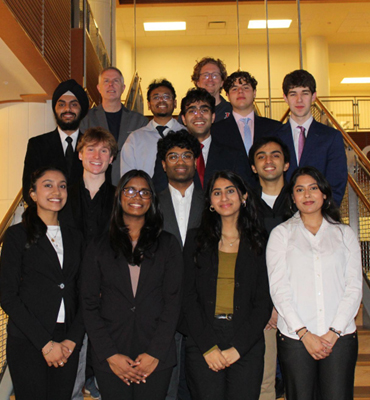
The Disruption Lab is mutually beneficial. It offers students a chance to explore emerging technologies like AI, work across disciplines to develop practical solutions and products for its clients, and strengthen their entrepreneurial mindset. Clients, on the other hand, receive deliverables that help move their product forward and important research that can advance startups closer to launch. The Disruption Lab has also provided market research for larger companies, like AMD.
Robert Brunner, the Chief Disruption Officer at Gies Business, developed the Disruption Lab in 2021 as a way to identify emerging technologies – like blockchain, NFTs, XRVR, Metaverse, and cryptocurrency – and explore how they might impact society and business in novel and unpredictable ways. It gives our students invaluable experience and an opportunity to provide their own unique perspectives. The Disruption Lab is divided into two branches: a StratLab, which can provide strategy, a business plan, and proof of concept, and a TechLab, which can actually build products.
“The Disruption Lab was an answer to the trend of industry research beginning to outpace academic research, especially in these emerging technologies,” said Sahib Bedi, Strategy Senior Manager for the lab. “Many times, we act as a copilot for a professor to help launch an idea.”
Through the Disruption Lab, students have a real-world classroom to learn these technologies more rapidly than they might with just classroom instruction. Some of the students may have had an internship in the space, while others simply have a passion to learn more.
“Some of those who turn out to be the highest performers are those who had little knowledge of the subject coming into it,” Bedi said.
The StratLab deliverables generally fall into two camps – primary research, like facilitating interviews, which lead to customer discovery reports, and secondary research, like industry reports, which give the client a lens on the market.
Disruption Lab is housed in Gies College of Business and is open to all students across campus. While Gies Business and Grainger Engineering students comprise a large percentage of the teams, the Lab also includes students from other colleges, like the iSchool and the College of Liberal Arts & Sciences. TechLab and StratLab each generally accept about 7-9 projects each semester.
“We are looking for projects that will have an impact at Gies,” said Adam King, Gies’ Director of Innovation and Transformation. “We are constantly looking at our purpose, commitments, and beliefs. Do we think it’s a good learning opportunity for students?”
The students generally spend multiple semesters with the lab. They start by working on a project, and after several semesters, they move up to become a project manager, an engineering manager, or a senior analyst.
“That is valuable to them as they are applying for jobs or internships,” King said. “It speaks to the great work that the student team has done to create an environment where there are opportunities, and students want to stick around.”
Former Disruption Lab students have moved on to positions at companies like Amazon, Jane Street, Capital One, Microsoft, Goldman Sachs, Google, JP Morgan, Bain & Company, and Deloitte.
The growth of AI at Disruption Lab
King reports that in the fall of 2024, the TechLab saw two AI projects. By the fall of 2025, that jumped to about half. This semester, it’s now about 80-90 percent.
“In a lot of emerging technologies, there is a learning curve that might be met with students from more of an engineering background,” Bedi said. “With AI, it is much more of an agnostic space where there is an easier ability to learn. Because of that, we can build something out of it quickly.”
Some of the projects, like Trencevski’s AI 3D modeling project, cross both the StratLab and the TechLab.
“In some cases, the technology side is working to understand the hardware components, and the strategy side is understanding how we operationalize underutilized labs through something like hyper-performance computing and AI,” Bedi said. “It is really cool to put a business student and an engineering student in a room and see what they can come up with.”
Currently, a team is working on an academic advising chatbot for the business minor.
“Previously, it might have taken a lot of time to understand the logic of the chatbot and its configuration,” Bedi said. “Now, with AI and the platform they have been using, Illinois Chat, we have seen business students able to build it much quicker, and we’ve discovered that there is a significantly lower barrier to entry.”
“We are constantly exploring the ways AI can take it to the next level,” said Jamie Nelson, Associate Director of Educational Innovation for the Center for Innovation in Teaching and Learning (CITL). “Can we discover something new? Can we spur up new ideas? Can we validate existing ones? It is incredible how much it has grown over the past couple of months and how much value it can have to projects.”
The proof is in the deliverables
Disruption Lab teams are using AI to help with ID verification; using large language models (LLM) to leverage otherwise useless hardware to run local AI models and unlock AI computing locally in a secure way; using AI to chart the route a drone delivery takes; and developing a generative learning platform where they are researching and generating content on the fly using AI. There is a team working with the University of Illinois Sponsored Programs Administration (SPA) office on a go-to-market strategy for an AI product. Another is working with faculty members to use AI avatars and chatbots to take students on an immersive simulation of a customer discovery platform.
Count Trencevski as someone sold on what Disruption Lab can do. Last semester, the StratLab developed a website where students can upload their 3D models, and professors can create a group for different projects. That way, all the students can visualize the same 3D model. This semester, a TechLab team is taking those models and tying them back to some LLMs with AI in the back end so they can modify those 3D models.
“I was impressed with what they were able to accomplish in those 16 weeks,” Trencevski said. “They created a prototype/proof of concept and successfully demonstrated that the 3D model could be uploaded. They even had a VR headset where you could visualize that model.”
The Disruption Lab is currently taking applications for both students and clients.
Photo courtesy of Alexander Boukalis