
Mar 9, 2026
What CES 2026 Reveals About the Future of Business Education

By Andrew Dahle and Jamie Nelson
Walking the floors of the Consumer Electronics Show (CES) this year, moving from keynote halls to crowded show floors, we expected to spend the week thinking about products; instead we kept noticing patterns. CES has always been a place to see what’s new – and it was – but this year it felt a little less like a glimpse into the future and more like a preview of what’s about to feel routine.
One thing that stood out to both of us was how little anyone talked about gadgets for their own sake. Executives and engineers kept coming back to the same idea. We are no longer debating whether certain technologies will matter; we are figuring out what it means to live and work once these technologies are just part of everyday life. That shift from novelty to normalcy felt especially significant.
From where we sit as educators, CES didn’t feel like a trade show as much as a live case study. It was a window into how work is being reorganized, how strategy is evolving, and how leadership expectations are changing. The same themes kept coming up – no matter where we went or who we listened to – each with direct implications for how we prepare students for what comes next.
1. AI as Infrastructure, Not a Tool
Across messages by leaders from Nvidia, Siemens, Microsoft, Qualcomm, Caterpillar, and others, there was remarkable consistency in how AI was described. Not as a feature. Not as a productivity hack. But as infrastructure. Speakers kept using familiar analogies like “the next electricity,” “the next internet,” and “the next general‑purpose technology.” because they needed language big enough to capture the shift.
That distinction matters more than it might sound at first. When a technology becomes infrastructure, advantage doesn’t come from simply adopting it. No company wins today by proudly announcing that it uses electricity. Advantage comes from how organizations redesign themselves around what that infrastructure makes possible. It starts to change how decisions get made, how work flows, and even how organizations are structured.
This is an important reframing, especially for students worried about their future job disappearing because of AI. Students don’t need to compete with machines on technical capability. They need to understand how widespread technologies reshape industries and how leaders make choices when the tools are broadly available. The strategic questions for leaders and students alike become less about whether to use AI and more about how to empower with it.
2. Human Work Is Quietly Moving Up the Stack
Another idea that came up everywhere, especially in sessions with McKinsey, General Catalyst, and PwC, was how human work is changing. Consulting firms, technology leaders, and industrial companies all echoed the same point: generative AI is increasingly handling the routine tasks that have absorbed too large a share of white-collar effort. What’s left are tasks that are harder to automate – human judgment, creativity, and context.
This has real implications for how we think about education. If retrieving information, generating first drafts from key ideas in prompts, or running standard analyses can be done instantly, then those activities can no longer be the endpoint of learning. They become inputs. The value shifts to asking better questions, interpreting ambiguous signals, and making decisions when the data is incomplete or conflicting.
CES confirmed what many of us already suspect: the future business leader is defined less by what they know and more by how they think. And just as importantly, by how well they can collaborate with people and intelligent systems rather than compete against them.
3. Digital Twins and Robotics Are Redefining Industrial Strategy
One of the more striking moments at CES was how companies described a world in which physical systems are now designed and stress-tested digitally before they ever exist in the real world. In fact, some went as far as to say digital twins will be mandatory for major physical assets.
Digital twins, robotics, and simulation have the power to condense timelines that once stretched over years. Entire factories can be modeled, optimized, and reconfigured virtually. That changes not only how things are built, but how risk is managed, capital is allocated, and strategy is executed.
Lines that used to feel clear are starting to blur. “Digital strategy” and “operations strategy” are no longer separate conversations. A key competitive advantage is now the ability to use digital representations of the physical world to inform real-time decisions. Our students will need to be as comfortable thinking about automation and simulation as earlier generations were with globalization or supply chain fundamentals.
4. Automation as a Design Choice About People
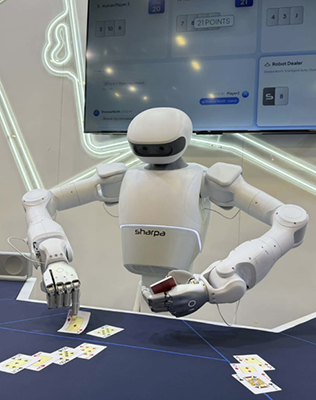
While efficiency often dominates discussions of automation, CES highlighted another dimension: human safety. In construction, mining, and infrastructure, autonomous systems are increasingly taking on the most dangerous and grueling tasks.
What stuck out was how explicitly some leaders framed the tradeoff. Machines should take the risk. Humans should make the judgment. It reframes automation as a design choice about human roles and quality of life, not just a bottom-line financial calculation.
For business education, this matters deeply. Technology decisions are never purely technical or financial. They shape dignity, safety, and opportunity. Preparing students to lead in automated environments means teaching them to evaluate success not only through ROI, but through long-term human and organizational outcomes. The most credible leaders are the ones who treat people as assets to be supported and elevated, not expenses to be eliminated.
5. When Intelligence Disappears Into the Background
Finally, one of the subtler takeaways from CES was how invisible the most powerful technologies are becoming. In mobility, wellness, consumer devices, and emerging XR wearables, intelligence is moving off screens and into the environment. It’s embedded, contextual, and often unnoticed – yet very powerful.
That changes how companies should think about innovation. The future is less about eye-catching interfaces and more about empowerment, interoperability, and trust. Systems that quietly work, adapt, and integrate into daily life are the ones that endure.
For students, this reinforces the importance of systems thinking. Breakthroughs rarely succeed in isolation. They succeed when technologies, organizations, and users align over time. Some of the most important innovations stop looking like innovations at all. Spotting that shift early is a real managerial skill – and one that business education must actively cultivate.
A Closing Reflection
Leaving CES, we felt even more optimistic about the future value of business education and more convinced of its importance. As tools become more powerful and more accessible, human judgment becomes more valuable, not less. The role of education is not to chase every new platform, but to help students develop ways of thinking that endure when platforms inevitably change.
For students who feel uncertain – or even uneasy – about AI, our advice is clear. Don’t measure your value against what machines can do. Measure it against your ability to learn continuously, to adapt thoughtfully, and to lead responsibly in environments shaped by those machines. The future will not belong to people who resist technology, nor to those who blindly celebrate it. It will belong to those who can integrate it into human systems with clarity and purpose. At its best, business education prepares students to do exactly that.
Andrew Dahle is a clinical assistant professor of accountancy at the University of Illinois’ Gies College of Business. He spent the last two decades as a Partner at one of the largest accounting and consulting firms, eventually retiring and joining the faculty at Gies Business in 2022.
Jamie Nelson is associate director of educational innovation at the University of Illinois’ Center for Innovation in Teaching & Learning and Gies College of Business. Over the past 20 years, he has focused on leveraging emerging and disruptive technologies to transform the learning environment for learners of all backgrounds and stages of life.