What does it take to lead when the pressure is high, the path forward is uncertain, and failure is inevitable? More than 1,000 students, faculty, and staff gathered on September 2, 2026 to hear four accomplished leaders from the University of Illinois community share lessons forged in boardrooms, locker rooms, government offices, and high-stakes moments throughout their careers.
Moderated by Brooke Elliott, Josef and Margot Lakonishok Professor in Business and Dean of Gies College of Business, this group of notable alumni and leaders from the University of Illinois community included:
- Larry Gies (ACCY '88), Founder and CEO of Madison Industries
- Shauna Green, Head Women’s Basketball Coach, University of Illinois
- Sam Skinner (ACCY '60), Former US Secretary of Transportation (1989-1991) and White House Chief of Staff (1991-1992)
- Josh Whitman (FIN '01, LAW '08), Director of Athletics, University of Illinois
Their discussion covered a wide range of topics related to leadership and the panelists’ experiences. The following provides just a sampling of the insights shared at that panel discussion. These have been edited for length and grammar.
On leadership
Brooke Elliott: “Each of you has led organizations and perhaps multiple organizations. Just tell me a little bit about what leadership means to you today.”
Larry Gies: “A leader is somebody who cares about their people, communicates very well, and is very honest and humble about what they know and they don't know. I think those three traits are super important.”
Sam Skinner: “A leader is someone that can bring a team together and bring them forward. Cares for them. He sets them on a course. He sets them on a purpose. He knows, this is what we’re going to do. You're on my team. You're with me. And they all respect the one who’ll do that, and they'll follow. But you don't have to be a leader to be part of the team. There’s no I in team. And it's just as important to be part of a team as it is to be a leader.”
On purpose
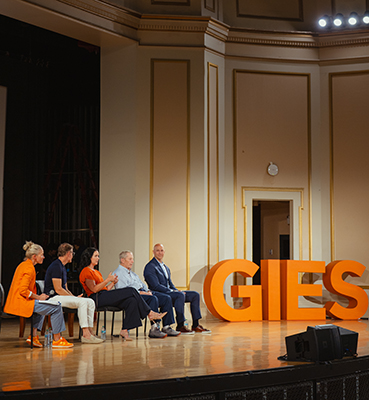
Brooke Elliott: “At Gies Business, we’re talking about business on purpose. And when I talk to students, I talk about purpose. It's all about exploring your passions, finding your interests, building a skill set, and then using that. Going out into the world and something good. It really is the center of what we do at Gies. So, how do each of you think about purpose within your organizations, or how has purpose shaped what you do as a leader?”
Josh Whitman: “I think purpose is everything. In our organization, we use our mission statement as our purpose. It’s meant to be clarifying. It's meant to provide the north star that helps guide our decision making in moments of confusion or uncertainty. I think it's that thing that that helps create cohesion and unity among a group of people to drive them in a certain direction. And as you will find out – if you haven't already – there are lots of moments where there are going to be pressures on the organization and the team you're part of to try and pull people different ways. Being able to collectively focus on that purpose helps to marshal everybody in the same direction and ultimately puts the organization best position to be successful.”
Shauna Green: “We just talked about purpose yesterday in our practice. We had a talk about ‘What is your ‘why?’” What do you love about this? Why are we doing this every single day? So purpose for us drives performance. Purpose is everything. We all know where we want to get. As a team, we know where we want to get. So, every single day, really evaluating and reflecting and being very intentional on what you're doing and why you're doing it. Number one, for yourself. Number two, for your team.”
On leading under pressure
Brooke Elliott: “I’d like to talk about leading under pressure and feeling completely under pressure all the time. Can you talk about what things are important when you're put in an environment where you have to lead under pressure?”
Shauna Green: “I think it's like anything – confidence, right? So just having that calm, confident demeanor. Now you guys have seen me coach. Sometimes I don't look calm. Always confident, but sometimes I'm not calm. You have to train and prepare for those situations. I say all the time with our team: reps lead to confidence, confidence leads to success. If you prepare, preparation is going to equal you being a more confident version of yourself. So when that tight game comes, we prepared. We've gone over every scenario, what could happen in that moment, and then what we would do. So now that’s just like second nature to us.”
Sam Skinner: “I found that the first thing I do is I take a breath, slow down a little bit. Number two, surround myself with good people to help me solve what's creating this pressure, and trust them. They have to help me find the solution. Number three, once you've done that, then you got to make a decision. You can't kick the can down the road. And if it doesn't work out, you’ve got to let it go. You’ve got to put it on the back burner and move on. Execute, get the result, celebrate it if you’ve solved it, and move on.”
On leadership in a changing environment
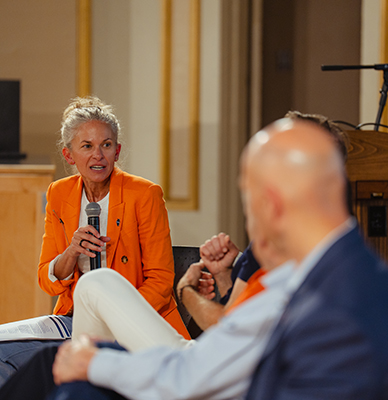
Brooke Elliott: “What does leadership look like whenever you have to operate in a changing environment, and what skills really stand out as strengths to be successful in an ever-changing world.”
Josh Whitman: “So much of leadership is effective judgment and knowing there are moments we all want more information. We always want more information, but there will come a moment when you can no longer wait to get more information – where you will do more harm by waiting than you will good by perfecting your decision. So, you've got to be prepared to make calls in the face of incomplete information. You have to be prepared to accept that those decisions might be wrong, that you might do a lot of work to implement something that you might implement for a short time, and then you're going to pivot away from that almost as quickly as you put it in place. I think, at the end of the day, it comes back to something we talked about earlier, which is its purpose and its values. You have to be able to make decisions based on those values, even when the map may be a little bit murky, where it's not exactly clear which direction you should go.”
Larry Gies: “I think Josh said perfectly. That is, things are going to change. The one thing I can promise you is tomorrow is going to be different than today. The world is going to continue to change. As a leader, you have to get to 40,000 feet and figure out what needs to be done and then get into detail. When COVID hit our organization, I told people, I don't know what's going to happen, but I was very confident that we're going to get through it because we have the three main things you need to have: one, you care about people; two, you care about people; and three, you care about people. At the end of the day, if you care about people, and they know that, I’m confident that we as a team, we’re going to get through this.”
On creating a winning culture
Brooke Elliott: “I'm pretty sure that everyone on this stage loves to win. Talk a little bit about what it means to create a winning culture.”
Shauna Green: “You're in this to win, right? Yesterday in practice we talked about purpose. We talked about the will and that desire to win. And not just winning games – that's the end result – but winning in terms of how you show up every day. And I think that's just so important, because it is the process. We all know where we want to get, but how are we going to attack each and every day? And the standard is a standard. So as leaders, we do have to hold them accountable. You have to set the standard. If we're asking them to do something, I need to be doing that. So it's just again creating a high level of standards, accountability, and creating a culture.”
Sam Skinner: “Winning can be obsessed over. If you put a team together, get the best people you can find. You put your best plan together. You show up. And for whatever reason, you may not be the winner, but your team has done everything they possibly could. Some circumstances have occurred that were totally outside of your control. You cannot send that team home saying you lost. Now you can say that ‘we better start doing better’. But there are some situations where winning is doing the absolute best job you can, and applaud ourselves and say, ‘Next time.’ So don't think that if you got a winning team, you're going to win every time. And if you win, you gave your best effort. If you lose, you learn from your losses and you continue. That doesn't mean that's not disappointing, but when you come back and reflect, you say ‘we really did our very best’. That's what your winners do. That's what leaders do. They look through it, and when they're down, we'll say to them in the locker room, ‘we’ll get them next time.’”
On failure: is it strategy or people?
Brooke Elliott: “Next question is about failure. As we know, if you don’t fail, you won't learn, right? And so failure is such an important part really of what we do. As you think about your greatest failures, has it been a strategy failure or a people failure?”
Larry Gies: “It's always about people. You're only as good as the core people you have around. And all of my severe failures were because I didn't act on people that weren't getting it done, or I had people in the wrong spots – and that's on me, not on them. And somebody said earlier, they talked about making decisions fast. That bias for action. Take a deep breath. Sam said it – make that decision. Have that bias for action.”
Josh Whitman: “I think from a failure perspective, with an organization the size of Athletics, there’s failure across the organization every day. And it's important as a leader that you create an environment where that failure is not only tolerated but supported – where you are creating an environment for people to learn through failure. You either win or you learn. The only failures that you can't accept, in my opinion, are failures that come from either, one, impure motives – so people who are deceitful or acting with a bad intention – or two, failures that that happen because people are lazy. I think that’s a really important distinction to make. We all fail. And you need to set that example for the people who are around you so that they understand that failure is not only acceptable but supported.”