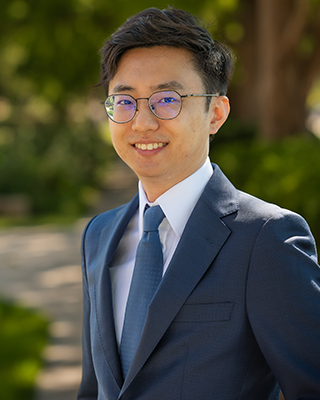
At heart, Lin An is a math guy. A native of China, An majored in mathematics and economics as an undergrad at Boston College. He realized early on that mathematics could help businesses make better decisions, an interest that now shapes his research on AI and operations management.
That makes Illinois a natural home for An’s research. Earlier this year, he completed his PhD in algorithms, combinatorics, and optimization at Carnegie Mellon under Professors Andrew A. Li and Ben Moseley. Moseley earned his bachelor’s, master’s, and doctoral degrees in computer science at Illinois. An joins the Gies Business faculty as an assistant professor of business administration, with a focus on operations management and opportunities to collaborate across business and computer science.
“I realized that although I enjoyed pure math, I was interested in using it to have direct impact,” An said. “My research is at the intersection of AI and business operations. At Gies, I see a lot of potential opportunities on both of these fronts. Illinois has a great reputation in business and computer science. As a result, I have access to talent in both fields and can find ways to bridge these disciplines.”
An brings a broad knowledge base. He has a Master of Science degree in operations research from Columbia University’s Fu Foundation School of Engineering and Applied Science.
For An, a business school provides a setting where practical questions can shape the development of new mathematical methods. His work connects algorithm design with the choices companies face about serving customers and managing resources.
A significant amount of An’s research explores how companies can use AI in decision-making.
“I think every industry is asking the same question: How do we operationalize this new and exciting opportunity of AI?” An said. “My vision is to establish an optimization foundation that allows our field to fully leverage AI, looking specifically at how companies can adopt AI techniques in decision-making.”
One current project, “Does Variety Drive Engagement in Short-Form Digital Content?” examines how variety in short-form content relates to user engagement.
He is also a co-author of a recent paper titled “Real-Time Personalization with Simple Transformers,” which explores how AI models can support fast, effective recommendations.
Transformers, a type of AI model widely used in language modeling, can also capture how a customer’s preferences depend on the items they have already seen or chosen. But predicting preferences is only part of the problem: a business must decide what to recommend next, often almost instantly. An’s research develops methods to make those decisions efficiently.
An is looking forward to engaging with companies that Gies Business faculty are already connected with and developing methods to address problems in business settings. Those operational challenges can guide new research, with collaboration across business, computer science, and engineering helping to turn AI’s capabilities into better decision tools.
He cautions that simply following the output of a large language model does not guarantee a sound business decision. “The human experts must have a say in this,” he said.
At the same time, he sees opportunities that companies may miss if they remain tied to familiar systems.
He aims to combine AI with optimization and human expertise. “Our vision is to find a way for these new AI systems to help companies make decisions,” he said.
The interplay between human intuition and algorithms also draws An to another passion: playing poker, specifically no-limit Texas hold’em.
Part of poker’s appeal is the chance to share a table with accomplished professionals. An, who grew up watching poker on television in China, has played at the same table as Joseph Cheong and Chino Rheem, who each rank among the top 75 on poker’s all-time money list with more than $20 million in career earnings, and poker player and content creator Ethan “Rampage” Yau.
This summer, An spent two weeks in Las Vegas during the World Series of Poker (WSOP), playing several tournaments. His poker accomplishments include a runner-up finish in a $1,000 buy-in WSOP no-limit hold’em six-handed event, his biggest score to date, and a WSOP Circuit ring in 2024.
“I use my brain for work and for relaxation,” An said. “In poker, there are many components that are related to business research. There is a very rigorous algorithmic approach to it, and also a very human approach to it.”
An has enjoyed getting acclimated to Champaign-Urbana; he is impressed with the quality and quantity of Chinese food in a college town, making it feel like home.
Reflecting on his 10 years in the United States, An notes how rapidly AI is changing the tools available to researchers and students.
In the spring, An will teach Big Data Infrastructure and is looking forward to incorporating AI tools into the course.
“These are challenging times, but they also bring many opportunities,” An said. “In my previous work, I was more of a theory guy – developing algorithms and proving theorems. But I think in a business school, it is crucial to be linked to actual applications. I’m excited to find ways to integrate them into the classroom.”