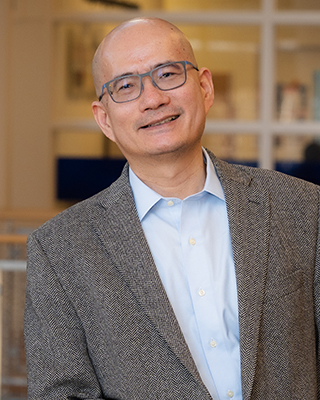
To recognize his exceptional contributions to academic research, doctoral mentorship, and classroom instruction, Gies College of Business at the University of Illinois celebrated the investiture of Jiekun Huang as the Richard S. Williams Professor of Finance on August 26, 2026.
The Richard S. Williams Professor of Finance is a prestigious honor at the University of Illinois that recognizes excellence in the study of finance. Williams was a 1951 Gies Business alum and Navy veteran who moved to New York to become an investment banker for Kidder, Peabody & Co. He later served as an executive at E.F. Hutton. Richard and his wife, Millie, established an endowment upon his retirement in 1981. Williams died in 1997, followed by his wife in 2001.
“It is truly an honor to receive this recognition,” said Huang. “Mr. Williams passed away almost 30 years ago, but his generosity continues to make a meaningful impact, and I am deeply privileged to carry his name. I hope to use this professorship to keep pursuing questions that matter, and to support students and younger scholars as generously as others have supported me.”
Revealing the mechanisms behind markets and corporate decisions
Huang’s research focuses on how economic agents—including investors, corporate executives, and political figures—and the interactions among them shape the informational role of financial markets and corporate decision-making. His work spans four key areas: how information is produced and priced, the influence of institutional investors on firms, the intersection of finance and politics, and social and environmental forces shaping financial decisions and outcomes.
Among his most influential studies is “All the President’s Friends: Political Access and Firm Value” (published in Journal of Financial Economics), which he co-authored with Dean Emeritus Jeff Brown. The study analyzed White House visitor logs to show that companies whose executives met with high-level policymakers saw higher stock returns, went on to win more government contracts, and were more likely to get regulatory relief. The paper gained widespread national media coverage, including features in The Wall Street Journal, NPR’s Morning Edition, Financial Times, The Economist, and Bloomberg.
His Editor’s Choice article in the Review of Financial Studies, co-authored with Meng Gao, “Informing the Market: The Effect of Modern Information Technologies on Information Production,” examined the SEC’s staggered rollout of the EDGAR system in the 1990s, which transitioned corporate filings from paper to digital formats. The study revealed that democratizing access to corporate disclosures led retail investors to make more informed trades and led financial analysts to issue more forecasts and more accurate ones.
In another study, “Give Me Your Tired, Your Poor, Your High-skilled Labor: H-1B Lottery Outcomes and Entrepreneurial Success” (Management Science), Huang and his co-authors, Stephen Dimmock and his late Gies colleague Scott Weisbenner, asked what access to skilled foreign labor does for young firms. Because the H-1B lottery awards visas at random, winners and losers were otherwise alike. They found that startups winning more visas raised more venture capital, patented more, and were more likely to go public or be acquired—which has become one channel through which skilled immigration feeds American innovation and job creation.
Huang’s research has been published in leading academic journals—including the Journal of Financial Economics, Review of Financial Studies, and Management Science—and recognized with honors such as the WRDS Award for Best Paper on Empirical Finance at the Western Finance Association meetings. His work has been cited more than 6,000 times on Google Scholar.
“Jiekun Huang embodies the very best of Gies College of Business through his groundbreaking research, dedication to our students, and institutional leadership,” said Brooke Elliott, Josef and Margot Lakonishok Professor in Business and Dean. “His work shining a light on the real-world connections between policy, information access, and financial markets provides invaluable insight to the field, and his commitment to developing the next generation of scholars ensures a lasting legacy at Illinois.”
A commitment to interactive teaching and doctoral mentorship
Beyond his research accomplishments, Huang is a deeply dedicated educator who uses a flipped-classroom model: students work through recorded lectures and the textbook before class, and class time centers on interactive dialogue and problem-solving. He regularly teaches FIN 321: Advanced Corporate Finance to undergraduates and FIN 521: Advanced Corporate Finance at the graduate level, connecting complex financial theory to current events, such as how markets respond to major regulatory shifts and national elections.
“Students appreciate having more control over the learning process, and I’ve found that it prepares them to think independently and to make a case in front of other people. That is how decisions get made in a company, and it is not the same skill as prompting a model,” said Huang, who is perennially named to the list of Teachers Ranked as Excellent by Their Students and was nominated for the Campus Excellence in Undergraduate Teaching Award in 2025 and 2026.
Since 2023, Huang has also served as director of the Finance PhD Program at Gies. In this role, he oversees PhD admissions and guides students through the program’s milestones. He organizes dialogue sessions and workshops to strengthen student–faculty engagement and meets with each student individually to discuss their progress and any needs or concerns. He has mentored 13 doctoral students at Illinois and elsewhere.
Huang earned his undergraduate and master’s degrees in finance from Xiamen University in China before moving to the US to complete his PhD in finance at Boston College. He is married to Meng Gao, an Illinois finance PhD alumna who is now a finance professor and a frequent research collaborator. They have two children, Boyou and Annabelle.