By John Moist
Bill Chase (FIN ’88) didn’t foresee business ethics becoming a defining concern of his work, but experience reshaped his thinking.
“I think ethics and behavior inside corporations are incredibly important - and every year I get older, I think they matter even more,” said Chase. “If you'd asked me back in 1988, I would have told you my ethics class was the most boring course I had to take; now I kind of think it might be the most important class you can take.”
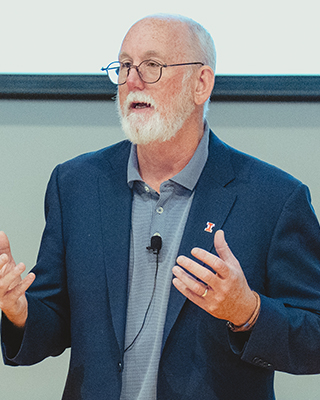
That’s how Chase, retired executive vice president and chief financial officer of AbbVie, framed his visit to Gies College of Business as this year’s Leighton Lecture on Ethics and Responsibility. In attendance at the Deloitte Auditorium on October 30 were learners from Yusaku Takeda’s business ethics course. Chase drew from his long career in life sciences finance – including the historic spinout of AbbVie from Abbott Laboratories and the development of Humira – to explore what it means to lead ethically within the constraints of fiduciary duty, regulation, and long-term corporate strategy.
Chase’s talk, “C-Suite Experiences from a Finance Perspective: Navigating Corporate Strategy and Stakeholder Responsibility,” gave the learners in attendance a view behind the curtain as he moved from his biography to case studies. He outlined how Abbott, a large and diversified healthcare company, spun off its research-based pharmaceutical business into AbbVie, and the challenges that process involved.
At the center of his remarks was the tension between ethical decision-making and fiduciary responsibility. That’s fitting for Chase, who recently established the Chase Family Research Fund at Gies Business to support research into ethical leadership in business.
“Fiduciary responsibility sounds like a boring term,” said Chase, “but if you ever want to sit in a public company’s c-suite, it’s probably the most important concept there is to understand. Management may run the company and hold the big titles, but we have a fundamental responsibility to the owners and shareholders to maximize their assets and deliver a return that’s worthy of the risks they’ve taken.”
That obligation raises the stakes for judgment and deliberation. For Chase, the first principle is that legal compliance is only a beginning.
“Ethical decision-making cannot just collapse to a legal standard,” said Chase. “Using legality as your bar puts companies, and capitalism as a whole, into a dangerous spot. You can’t just outsource these dilemmas to regulatory bodies or public opinion. At some point, management and the board have to make the call. That’s why, in my view, ethics for business is probably the most important topic in your curriculum. If you don’t have an enriched view of ethical values, you’re going to make some really bad decisions in the business world, and that’s bad for both your industry and capitalism as a whole.”
To make those abstractions concrete, Chase walked the audience through AbbVie’s acquisitions, structure, and processes for decision-making when intellectual property and investments were on the line. In each case, he stressed, leadership had to balance near-term financial outcomes with longer-term thinking about reputation, scientific process, and the company’s role in the broader healthcare system.
He also emphasized that the human experience and stakes of those decisions often look and feel different from the commentary that surrounds them.
“Being a leader of a large corporation is extremely complex and very difficult,” he said. “Solving problems often requires bold moves that can be very unpopular. Your responsibility to shareholders is non-negotiable, but you also have patients, employees, the healthcare system, and government regulation to think about. It’s not an easy thing to trade all of those things off.”
Chase invited learners to ask questions and interrogate those tradeoffs. Questions ranged from probing his thoughts on “aggressive” strategies in marketing to how he defined ethical leadership in an industry with so many products, patents, and lives at stake. Rather than offering easy answers, Chase returned again and again to the importance of judgment, character, and preparation – habits that allow leaders to handle the complexities of problems that demand more than checking with legal.
Those habits and tools, for Chase, might be what matters most. Courses that once felt like a requirement to be endured later looked like the most important part of preparing to lead.
“At the end of the day, the answer, to the best of my knowledge, is that we have to educate people on how to make ethical decisions,” he said. “Ethics for business, for the future of markets and capitalism, that’s probably the most important topic you have in your curriculum…it’s simply easier to do things the right way.”
The annual Leighton Lecture on Ethics and Responsibility is sponsored by the Center for Professional Responsibility in Business and Society and Gies College of Business. This lecture series is underwritten by generous contributions from Richard (’49) and Grace (’50) Leighton.