Editor’s Note: Through its Origin Ventures Office of Entrepreneurship, Gies College of Business is supporting entrepreneurial activities of both on-campus and online learners. The Origin Ventures Office fosters knowledge creation and dissemination by top faculty in the field and designs and offers the curriculum needed to bring that knowledge to the classroom. The office houses iVenture, an accelerator for top student startups at the University of Illinois, and co-sponsors the Cozad New Venture Challenge, which allows University of Illinois startups to compete for a pool of $550,000 in funding. This is one in a series of features on Gies teams participating in this year’s Cozad, which culminated in the finals on April 17.
As a wheelchair-bound individual, Carter Schott has been nervous that vehicles were not going to see him crossing the street. As someone who has difficulty raising his hand, he struggled to get a teacher’s attention in class. Schott has set out to solve both those issues with a product called Sol, a USB-powered lighting system that can attach to the back of a wheelchair.
The first product from Schott’s company, Innovative Independence, Sol sits above your head so there is 360-degree visibility. It has two settings: stable and flashing. If you're in class, you can switch to flashing to simulate raising your hand, so a teacher or professor knows you have a question or would like to contribute to the discussion.
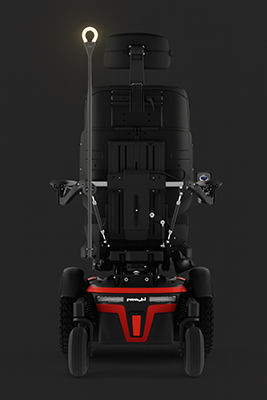
“Through this first-hand experience, I designed a product that was strictly for wheelchair users,” Schott said. “Currently, the only products out there are like flashlights, bike lights, or reflectors. I wanted to design something specifically for power wheelchairs, which led me to design Sol.”
A student in the Master of Science in Management (MSM) at Gies College of Business, Schott has entered the Cozad New Venture Challenge, hoping to get a piece of the $550,000 in funding offered this year, and to take advantage of the feedback offered through Cozad’s network of entrepreneurial experts.
Schott has already taken key steps toward bringing Sol to market. The idea originated three years ago while an undergraduate in mechanical engineering at the University of Illinois’ Grainger College of Engineering. Since then, Schott has leveraged several cogs in the University of Illinois’ entrepreneurial ecosystem. He made prototypes at the Siebel Center for Design and has worked with the (dis)Ability Design Studio at the Beckman Institute for user feedback.
The first iteration was dome-shaped, but after considering about 450 respondents on a Facebook post, Schott refined it to look more modern. He also made the mounting system more adjustable to be compatible with both manual and power wheelchairs, and easy to attach and detach when storing the wheelchair in the back of a car.
Schott is creating 30 pilot units of his latest Sol prototype to distribute for free across campus through Illinois’ Disability Resources and Educational Services (DRES) to further gather data on what might still need to be refined to make it more user-friendly. He has applied for a patent and is hoping he might have enough Cozad funding for a 10-year patent.
“My experience at Gies has been instrumental in helping me build a scalable business,” Schott said. “Through Cozad, I hope to get the word out about my product and develop relationships with other entrepreneurs, as well as potentially help fund some startup costs.”
Schott has reached out to multiple businesses that supply wheelchairs throughout the United States, who are helping spread the word about Sol. He also plans to work with the numerous Illinois Paralympians to market it further during the 2028 Los Angeles Games. Schott says he plans to take the product fully to market before working on other adaptive devices.
“I am building products for not only independence, but to make the user feel empowered as well,” Schott said. “Many of the people who, like me, are part of the Beckwith Residential Community (for students with physical disabilities) and wheelchair users. They definitely want to get their hands on Sol.”