Ashleyn Castelino and Keshav Dalmia aren’t getting much sleep these days. When they’re not in class, the two Gies College of Business master’s in business analytics (MSBA) students are competing in major hackathons and other extracurricular ventures.
“I think I’ve done about 40 projects outside of class,” says Castelino. That’s a lot of work for students already pursuing a masters at one of the country’s top business schools. But for Castelino and Dalmia, that effort is paying off.
In January, the two placed second in the most competitive track at the AgentX-AgentBeats Competition, hosted by the UC Berkeley Center for Responsible, Decentralized Intelligence. Billed as the largest open competition for agentic artificial intelligence, the event drew thousands of participants from around the world, all jockeying for $1 million in prizes and resources from major companies like Meta, OpenAI, and DeepMind.
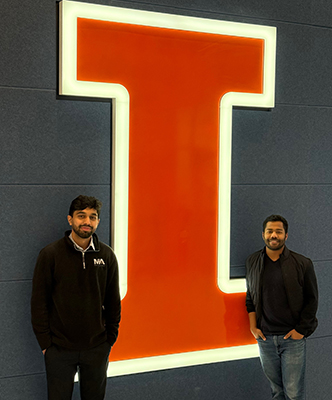
The two-phase competition challenged participants to first build new benchmarks for agentic AI – and then create AI agents to excel on them. Castelino and Dalmia knocked the first phase out of the park, creating an AI agent designed to evaluate SQL queries generated through natural language prompts.
SQL is the computer language that enables companies to utilize the vast quantity of data they collect every day, whether it’s Amazon analyzing shipping orders or Netflix mining your viewing history. Text-to-SQL makes it possible to explore that data using simple language prompts to generate reports. Sometimes, however, AI gets things wrong, generating fake tables and invalid functions that render that data useless.
The problem is being actively explored, but mostly in academic circles. “We wanted something that that could actually be applied in the industry,” said Castelino. So, they sat their cap towards that aim, first creating an AI agent that can score AI-generated results across seven different dimensions, including accuracy, efficiency, quality, and best practices. Now they’re on the second half of the challenge, creating a text-2-SQL program that can excel at the benchmark they created.
The two students hope the project will lead to a paper and possibly even a patent. But even if it doesn’t, their success has already raised their profile, scoring them invites to the exclusive Llama Lounge Hackathon, held earlier this month at the Silicon Valley AI Hub.
“Ashleyn and Keshav were invited to an event in San Francisco where only 200 people are invited, and they were the youngest of the lot,” said Vishal Sachdev, academic director of business analytics degrees at Gies Business, and the team’s biggest cheerleader. “Most of the others were startup founders and people in San Francisco who spend all their time doing that kind of work. So for two students from the Midwest, who are doing a full course of study, getting invited there for a weekend hackathon was really good.”
While they didn’t win at the second event, they don’t regret going. “It’s not about winning or losing,” says Dalmia. “It’s about how you solve real world problems. You’re outside the bubble, and you’re in a competitive environment where you have a chance to network. We got to talk to a lot of founders, venture capitalists and CEOs.”
Opportunities like that are made possible by a program that encourages students to excel, both through faculty support and financial assistance. For their trip west, for example, Castelino and Dalmia tapped into $500 of professional development support to cover their travel expenses.
They won’t need travel money for their next hackathon. In April, Gies Business will be sponsoring its first-ever, 24-hour Agentic AI Challenge, empowering undergraduate and graduate business students to build practical, automated solutions for real-world business workflows, using cutting-edge no-code and low-code tools. This time around, however, the two partners are on the sidelines, helping organize the inaugural event.
“There are a lot of opportunities you get here at Gies,” said Dalmia.
Castelino agrees, adding that those opportunities are key to a better learning experience.
“Whether you go to Gies or Harvard, there’s not going to be a drastic difference,” said Castelino. “What makes the difference is what you can do outside of those classes. That’s what will have a long-term impact on your life.”
Both men say their work has been greatly impacted by Sachdev, a major proponent of using AI in the classroom. He has encouraged them at every stage of their journey. “Every time I have a meeting with him, I think I know enough,” said Castelino. “But I walk in, and I come out learning more.”
For his part, Sachdev is just excited to see the two teammates pick up on one of the main lessons he shares with students, which is the importance of being curious, and building things, and learning from the things you build.
“The market doesn’t give you options if all you’re arriving with is a good GPA and a resume,” said Sachdev. “You have to come to it with a portfolio. It’s the only way to build your brand and differentiate you from the few hundred people who will apply for every job.”
Castelino and Dalmia are building their brand. And Sachdev says he’s not overly worried about the current sleep deficit caused by those efforts. “My guess is that both of them will get hired by a startup soon."