By Mike Koon
Jonathan Jachimiec has helped build the foundation for a Fortune 500 company. As CFO, he has helped negotiate a $400+ million sale of another company. He has overseen $1 billion in assets, has overhauled systems at an Australian division of a major pharmaceutical operation, and even co-founded a successful spirit company.
To get to where he is today has taken ambition, risks, and some provincial conversations. For instance, who knew that mentioning he drove the Zamboni at the U of I Ice Arena while an undergrad would open a door? Who knew having a conversation with a distiller across the street from his office would lead to a life as an entrepreneur? While Jachimiec couldn’t have imagined the specific path he has taken over the past two decades, he is among a growing number of future C-suite executives who have risen through a role as an internal auditor and from a school, Gies College of Business, that is strategically training and positioning its graduates for a similar journey.
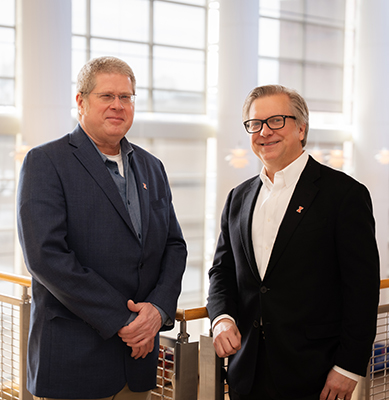
Jachimiec didn’t have internal auditing in mind while playing club hockey and pursuing both bachelor’s (2008) and master’s (2009) degrees in accountancy from Illinois. In fact, few do.
“I think a lot of people think you go into corporate accounting or you go into external audit, and that’s your career,” said Andy Dahle, clinical assistant professor of accountancy at Gies Business, the top-ranked accountancy program in the country, according to US News & World Report. “Internal audit is one of the best-kept secrets in the accounting profession. If you surveyed undergrads, they wouldn’t know too much about it. But hundreds of thousands of people are helping organizations succeed in that role.”
Dahle and colleague, Ed Rogowski, the academic director for the accountancy program and clinical assistant professor at Gies, have lived that path for major corporations, recruiting a high percentage of their teams from the University of Illinois. Both have returned to their alma mater to prepare the next generation of accounting professionals. Dahle was a partner with PwC for 24 years. As chief audit executive at United Airlines, Rogowski oversaw the transition to a cashless on-board sales system, saving the company tens of millions of dollars in lost revenue. He made similar contributions from high-level CAE positions at Hospira, Anixter, and Covetrus.
Jachimiec’s journey to the C-suite
Rogowski and Jachimiec first crossed paths at Hospira more than a decade ago, where Jachimiec was a senior internal auditor under Rogowski, who was the company’s vice president and chief audit executive.
“Ed was someone I admired,” Jachimiec said. “His view of internal audit was different than most. We actually outsourced our SOX testing (which evaluates a company's internal controls over financial reporting under the Sarbanes-Oxley Act). That not only allowed us to review their work but also to take on unique operational assessments to drive more efficient processes. That is something you wouldn’t typically find in an internal audit role.”
It was his work as an internal auditor for regulatory and compliance services at KMPG – his first job after graduating from Gies Business – that led to an internal audit role at Hospira. He noticed that many Fortune 2000s were building up their SOX practice internally, so he decided to do the same at KPMG.
His path into internal audit was admittedly a little providential.
“KPMG interviewed me for several different roles, but when I met one of the managers in internal audit, I mentioned working in the U of I Ice Arena, driving the Zamboni. I think that to this day, that sealed the deal. It was as if he said, ‘You drove the Zamboni? You’re hired.’”
His reasoning for joining Hospira after two years at KPMG resembles the attitude of many 20-somethings.
“I joined because I wanted to change the world,” he said. “Obviously, I am not an engineer or a scientist, but at the same time, the company still must operate efficiently and effectively to come out with new drugs. We were a generic pharmaceutical house. We prosecuted patents and were first to the market for many unique drugs that preserve life. We were selling WFI (water for injection) cheaper than you could buy a 500 ml water bottle at a convenience store. We were doing a lot of things that were able to save not only the hospital, but also the patients' money when they needed the drugs.”
After just a year at Hospira, Jachimiec was offered a short-term assignment out of internal audit to serve as acting controller for the company’s operation in Adelaide, Australia, where he said he cut his teeth and put his education to use. Jachimiec did a great job in his short-term assignment that turned into a permanent position. During a month-end close, he remapped the entire operation from a consolidation standpoint and was asked to transfer to Boulder, Colorado, to manage all aspects of finance and accounting for their API (active pharmaceutical ingredient) facility.

That’s when Jachimiec took the biggest risk of his professional life. Seeing that he had pharmaceutical experience, specifically in fermentation, a headhunter reached out to gauge his interest in joining the startup MycoTechnology in 2015. The company uses fermented fungi to develop value-added ingredients for food products.
“We were pregnant with our first child when I left a corporate job to jump to a startup, not knowing if it was going to work out,” Jachimiec (right) said. “At the time, Colorado was growing, and people were chomping at the bit for quality talent. What attracted me to that was ultimately to take a company public and build something from scratch. It was an opportunity that we felt could rebound if it didn’t work.”
As controller and then CFO for Myco, he built out the accounting, finance, IT, HR, and supply chain departments, negotiated and oversaw the construction of two plants, one of which was encroaching 100,000 square feet and contained more than $40 million in equipment.
“There was no job beneath us,” Jachimiec said. “All of us were shareholders in the organization. I traveled the world to find the right sources to go public.”
He brought together the top food technology syndicate from around the globe and helped raise $250 million in venture capital.
After seven years at Myco and three years as CFO for a mid-market software company, Jachimiec started his own consulting firm in 2025 and served as the interim CEO for the Morris Animal Foundation, with over $100 million in endowment. Currently, as CFO for In-Situ, Inc., he is spearheading its sale to Veralto for about $435 million.
Before his 40th birthday, Jachimiec had done about $1 billion in enterprise value in Colorado between growing MycoTechnology and selling In-Situ, while raising about $250 million around the globe.
And, yes, he co-founded Molly Brown Spirits, which makes bourbon entirely in-house. His future business partner in the endeavor was involved in a distillery across the street from Hospira.
“We started one from scratch to produce aged spirits,” he said. “It’s hard enough to make beer. It’s even harder to distill. It’s even crazier to put it in a barrel and hope that in a few years, it comes out good.”
Eight years later, Molly Brown Spirits is still going strong as they ask customers to “Give yourself a break from your everyday bourbon and dance with the Queen of Bourbons.”
Internal audit is giving accountants a path to the top
Part of the secret sauce of this growing phenomenon is that internal auditors have a seat at the board of directors meeting and are given major responsibilities in solving not only financial inefficiencies but also assessing processes within the company.
“Not many people get that kind of visibility within a company,” Dahle said. “Internal audit is kind of like cutting through functional lines like butter in an organization. As you’re doing this stuff, you’re learning the business. You’re not just staying in the accounting department; you’re going into new business units. When a business gets bought or when a new system gets put in or when there is a new risk that comes up in a certain area, you’re getting involved in those things.”
“I saw internal audit as more of a manager in hiring,” Jachimiec said. “You weren’t just working with the controllership; you were also working with operations and commercial finance. We got really good at asking questions, specifically the why. That doesn’t happen as much if you’re not in internal audit.”
“A lot of times,” Rogowski said, “companies will throw developmental candidates that they think are succession-eligible somewhere into a stint in internal audit because they’ll get a chance to see the company more broadly – how it works, understand how to improve the operations and the overall governance structure internal audit plays in a company.”
Internal auditors are asked to do risk assessments of the entire company, from a compliance operational perspective, from a regulatory perspective, and from a strategic perspective.
“The board of directors is highly interested in the overall risks to a company,” Rogowski said. “Because they are managing and providing independent governance to the company, they need to know what the top risks of the company are and how they are being managed. Are the risks increasing, are they staying the same, how is management monitoring the risks, and is management doing an appropriate job in managing the risks? Because the board relies on the internal auditor to evaluate the status of the risks for the board, Internal Audit has a lot of credibility within an organization.”
Dahle adds that big picture evaluations within a given company are frequently given to internal audit teams because internal audit has a company-wide role and brings an objective perspective.
“You need someone to take a fresh look from a risk perspective. That’s where internal audit comes in,” Dahle said.
“Internal auditors need to know how all the transactions flow through an organization and how the transactions flow to other organizations,” Rogowski adds. “Are we collecting the right information efficiently? Is it being used effectively? Internal Audit can then compare the company’s processes to ensure that they are aligned with the company’s strategic goals across the organization. “
Dahle adds that while internal auditors must have a strong background and knowledge in tax and accounting, it is, first and foremost, a people business.
“You’re working with people within the organization for positive change,” Dahle said.
“You don’t need to be the smartest person in the room, but you have to ask the right questions,” Rogowski added. “Not only ask the questions, but then say, ‘Is there a way we can do this more efficiently and effectively?’”
Gies Business strategically prepares students for careers in internal audit.
So, how does Gies Business uniquely prepare students for potential leadership roles, including an internal auditor?
“At Gies, all our classes teach critical thinking skills, which are essential in these roles,” Rogowski said. “People who graduate from here understand the technical side of the accounting business, but it’s not just memorization; it’s also how to use these rules and regulations and apply them to situations. Our students are working with teams to do that, like an internal auditing team, which works across organizations to get people to appreciate not only the technical accounting standards, but all the standards and regulations that a company might have.”
Dahle calls it “observing plus data analytics.”
To that end, Gies is pioneering an eight-week Internal Audit for Managers master’s-level class during the second half of the spring semester, geared toward individuals who might be interested in internal audit.
“Our students are exposed to some of these frameworks in ACCY 304, but we are hoping to develop this course and others like it to open a new path to a whole spectrum of internal audit professionals,” Dahle said.
Ultimately, Rogowski hopes this will lead students to become a certified internal auditor (CIA), which is along the same lines as a CPA, but more specifically focused on an internal auditor and their role within a company.
Dahle says the courses can mesh with BUS 301 (Experiential Learning) and be attractive to students in the Illinois Business Consulting program.
“If they like consulting, internal audit is a great way to do it,” Dahle said. “It’s not like they must sell every project as a consultant does; there is money set aside within the company to provide the service.”
“Gies doesn’t just prep students to pass the CPA exam, but also stresses the methodology behind it,” Jachimiec said. “That’s where I think not only my education, but also internal audit gave me the tools to ask those questions. The college gave me the desire and will to work hard. I was able to become the person that I am, and not let success get to my head, and not let failure get to my heart. You learn from failures and continue to build your career and be humble about it.”