By John Turner
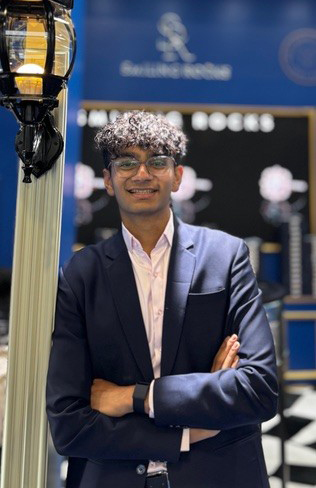
When Anand Jiwani studies overseas next spring, he plans to take in a soccer game or five, and conduct real-world testing of a web app he designed to help students studying abroad better manage their finances. If all goes well, Jiwani (right), a junior in finance and information systems at Gies College of Business, may even consider monetizing the app he created last fall as part of a class project.
That’s music to the ears of Vishal Sachdev, who led the course designed to help students to launch a solo business, using artificial intelligence tools as their coders, consultants and co-founders.
Since 2020, the course – BADM 372: Information Systems and Operations Management Practicum – has helped Gies Business students entering the workforce gain valuable, real-world experience while polishing their resumes. Typically, projects center around some type of collaboration with Fortune 100 companies that fosters creative problem solving. This year, however, Sachdev took a more entrepreneurial focus, transforming the course into “AI Solopreneurship & Product Building,” and inviting students with no programming experience to ideate, code and publicly launch a web or mobile product in just 15 short weeks – using only AI tools. That was exciting news for Jiwani, who had an interest in entrepreneurship, but no clue where to start.
“Taking this class gave me an idea how accessible it is now to start something,” says Jiwani. “Professor Sachdev was very interested in the whole AI industry, where you can use AI to literally make anything you want, whether it’s a simple financial assistant tool or something more complex.”
Jiwani’s app, MoneyNova, skewed toward the latter, providing a personal assistant to help students traveling abroad manage their money, plan trips and “navigate a new country with confidence.” Even though class is over, he continues to refine the app. He’s working with an outside company that will enable users to securely integrate their personal financial information in the app, making it easier to use.
This course is just one example of how AI is intentionally woven into the curriculum at Gies Business. Across courses and real-world projects, students harness AI to analyze data, generate insights, and solve complex business challenges. Gies pushes the boundaries of innovation to enrich learning and equip leaders with the knowledge, skills, and ethical grounding to thrive in a fast-changing, intelligent world.
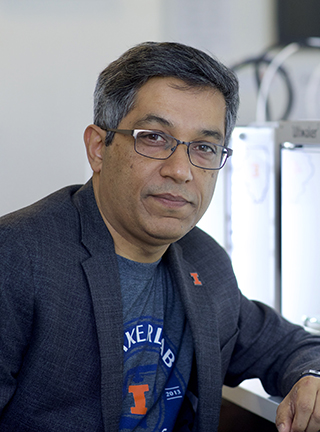
All 16 students in Sachdev’s course completed the assignment, creating apps that provide a wide range of services – from DormPlate, which focuses on college-based food delivery, to Tone Match AI, which uses AI to help users give their email the perfect voice. Each project started with pen and paper, and a lot of in-class discussion as students honed their concepts. But eventually, they all moved on to development, using AI to handle every aspect of their creation, from coding to design and even marketing.
“These are working apps that they built themselves with a database at the back end, and people can log in and use the functionality provided,” said Sachdev. All of those projects can be seen on a website that Sachdev developed, using the same tools he encouraged his students to use. It was his way of showing that he walks the talk while also creating a resource for all Gies students, faculty, and staff to showcase their projects.
Sachdev was impressed with his students’ efforts. Any one of the apps could conceivably be turned into a money-making business. But for Sachdev, that wasn’t the goal.
“I wanted to create a shift in mindset. Students were pushed to think like builders, founders, and innovators, learning to navigate ambiguity, leverage emerging tools, and iterate quickly. It wasn’t about making them entrepreneurs; it was more about saying, ‘OK, let’s push the envelope on what is possible by one person. How much can you do, using AI tools?’ In the process, students build the creative confidence that they can make something.” And that’s the main thing he wants them to take away from the course.
With today’s AI tools, Sachdev says students can be five times more productive, completing more work in a shorter period of time. And he hopes that students will learn to use those tools in the same way that previous generations embraced calculators and computers to reshape the world.
That resonates with Grace Monago, a junior double majoring in operations management and information systems, who signed up for the course before she knew about its new focus. Monago created FirstShares, an interactive, beginner-friendly chatbot, designed to help new investors learn important stock market terms and how to invest. And while she currently has no entrepreneurial ambitions, she took a lot away from her experience.
“You definitely learn all the things it takes to become someone who runs a business,” said Monago. “I had to come up with all the marketing myself. I came up with the idea myself. I had to code everything myself — with the help of AI — and push that out to a bunch of people. There’s a lot of hard work behind the scenes that’s usually not seen.”
But Monago found that work rewarding. She also developed an interest in coding and gained the skills she needed to create a website in another class.
Meanwhile, Jiwani sees applications that go far beyond the classroom.
“You’re actually learning skills that a lot of employers require,” says Jiwani, adding that companies are investing heavily in AI and will need employees with skills in those areas who can hit the ground running. Now, he has those skills, whether he seeks employment or takes a more independent path.
“I learned how to build something totally on my own, because I’ve got these great tools that are literally my co-founders and employees. And that’s super cool,” says Jiwani, who benefited from the strong, hands-on learning approach. “Over time, you tend to forget what you learn in some classes, but I think I will definitely be taking the skills I learned in this class into my future.”