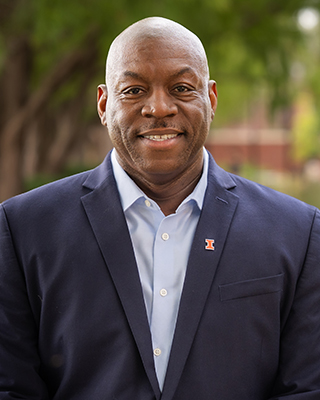
William Reed joins Gies College of Business this fall as a teaching assistant professor of business administration, bringing a background in military leadership, expertise in organizational consulting, and a clear passion for teaching.
For Reed, it’s essential that students know that the person asking them to think through a difficult problem is invested in helping them succeed. That conviction, a commitment to each student’s individual capacity, comes before the lessons in business ethics and management decisions.
“We have to do our part to confirm with people that we care before we will ever know what they know,” said Reed. “Through a series of unfortunate and fortunate events, I try to live by that when I walk into the classroom. Before learning can take place, they’ve got to see the public good in Reed. Before we can ever get to the simulation, before we can ever get to talking about what we learn, they’ve got to know that I’m their advocate.”
Reed’s commitment to his students gives his teaching purpose. He wants students to see in themselves the capacity to lead and succeed, and to understand the responsibility that comes with that opportunity.
Learning to Lead by Listening
Reed began to learn the importance of listening during his time in military leadership when he received the call to command as a captain. That role put him in charge, but it also showed him the value of learning from those whose experience exceeded his own.
“As a young officer in the Army, I realized that I could not be as effective without listening and being receptive to other officers and to my first sergeant, your senior enlisted counterpart, who knows just about everything,” said Reed. “He’s got 20 years in the military, so there’s very little that your first sergeant has not seen. The challenge for a young Army officer like me is to listen, observe, learn, take notes, have empathy, and have humility.”
Listening, for Reed, is a way of staying attuned to what a situation actually requires. Reed describes that awareness as taking an organization’s “pulse”: knowing the shape of what’s happening among the people doing the work, even when you can’t be present for every conversation, decision, or outcome. That disposition follows him into the classroom, where he prioritizes taking a step back, listening, and understanding his students’ needs to help them succeed. He models, in those moments, the posture he’s teaching to students.
The Value of Being Valued
Reed’s research about psychological safety explores that same connection between how people feel about their value in an institution and how they contribute.
“I spent a year down in the Deep South writing about this idea of psychological safety, about trying to create an environment where the student, even the extended family that’s not here with the student, and the faculty feel valued,” said Reed. “We feel comfortable challenging assumptions, raising our hands, giving constructive feedback, and getting meaningful criticism and guidance. That started me on a three-journal series trying to define how we make people feel valued.”
His consulting work gave him opportunities to put that perspective into practice. During one visit to a catfish processing facility struggling with turnover, Reed took an unusual approach: he asked to spend time on the production floor before meeting with leadership.
Upon his return, he didn’t ask questions about production workflow, absentee policies, or efficiency gains. Rather, Reed asked about how the leaders ensured that their workers felt valued and heard. When, for example, had they last made it clear that they cared? Understanding the business, he said, required understanding the experience of people doing the work – forging a real relationship. Our intentions, Reed cautions, may not match others’ experiences. To cross that gap, leaders have to be comfortable being uncomfortable and listen carefully to the answers given – even when they’re not easy to hear.
Finding Alignment at Illinois
At Gies Business, Reed teaches Business Dynamics (BUS 201). His students often work through simulations of business situations, making decisions and exploring the consequences of those choices across a company.
“When students make decisions within the simulation, it causes a ripple effect and affects different variables within their company,” said Reed. “The exercise this semester is to explore what you’ve done and what you agreed on, but also ask: Do you understand what you did, and do you understand how it affects the whole? Now what do we do? How do we course correct?”
Those questions challenge students to take responsibility for their thinking while leaving room to learn from what happens next. Reed sees an immense amount of talent and potential in his classrooms. In his telling, his role is to help students develop those talent through collaboration, reflection, and the experience of making difficult choices.
Reed believes in the power of those choices and that training to inculcate in students an ability to keep moving forward through challenges – even when the odds seem stacked against them. He likens that to Star Trek Captain James T. Kirk’s refusal to accept no-win scenarios. For Reed, there’s no such thing. Leadership calls us to keep looking for a way forward, even when there doesn’t seem to be one. Teaching gives him a way to help students develop that same belief in their capacity to make things better.
“Ultimately, the world doesn’t get better with me just reading The New York Times, looking at YouTube, and watching an hour of incidents on the Chicago news,” said Reed. “Things don’t get better unless Will does his part. So I made a decision to assume the role of the servant and do whatever I can for these kids so they can have their place in leadership. It starts with me.”
Reed’s move to Illinois brings those commitments into a setting where he sees a shared emphasis on belonging. At Gies Business, he recognized ideas he had been working toward throughout his career: people need to feel heard, seen, and valued to contribute.
“Everything I read about this place, long before I even knew I would have an opportunity to work here, was about belonging, about people, about being heard, and about confirming with people that they do matter,” said Reed. “That doesn’t exist everywhere. I think I’ve always been that way; I just didn’t have all the pieces. I wouldn’t rather be anywhere else now because I know I’ve found a place that aligns with who I am.”