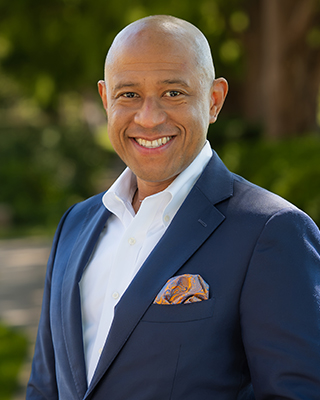
When David Charles arrived at the University of Connecticut in the late ‘90s, the stars were aligning in his favor. He had a strong technological bent, and the dot-com era was just beginning to unfold, which meant the world was his oyster. “I thought, ‘Wow! This is cool, because it’s what I enjoy working on and it’s also in demand,” said Charles.
After completing a degree in information systems, Charles headed straight for the heart of the action, landing a job with a data integration software company in California. “I was fortunate to work for Informatica just after they had gone public,” said Charles. “So, there was a lot of energy, and I got to see the excitement of Silicon Valley up front. We had a product that was in demand, I was working with awesome people, and I was learning a ton.”
From there, Charles worked as a data warehouse technical project manager and lead architect at Voya Financial in Connecticut before pursuing an MBA at the Tuck School of Business at Dartmouth.
“That was eye-opening, because I didn't know how much was possible, and I got exposed to so many other careers,” said Charles. At Tuck, he discovered management consulting, investment banking, and many other areas where he could apply his expertise. And that put his career on a whole new trajectory, eventually leading to work at two Fortune 500 firms.
The first was CVS Health, where Charles built out a marketing analytics group in the company’s pharmacy benefits management business and helped develop its national prescription refill service.
“Basically, we were applying direct marketing principles to drive better healthcare outcomes,” said Charles, who found the project deeply satisfying. “At the end of the day, if you’re keeping people on their medications, they’re healthier, and you’re probably lowering the costs for their employer. And when the company also makes money, that’s a win/win.”
In 2013, Charles moved on to Deere & Company, a global leader in agricultural and construction machinery. There, he quickly rose up the ladder, eventually becoming director of Workforce Planning and People Analytics. Around that time, he also became a leadership coach within the company, where his natural teaching instincts came to the fore.
“I was constantly doing something with early career talent, whether it was mentoring or advising people on possible career paths, and I realized there was always this constant thread in my work,” said Charles. “It’s kind of funny, when I moved over to higher education, my parents pointed out that I had always been some kind of educator, so teaching was a pretty natural transition for me.”
His journey to teaching started when he served as the manager of Data-Driven Innovation at the John Deere Technology Center. Located in Research Park at the University of Illinois, it was that job that drew him deep into the school’s orbit.
After completing a doctorate in organizational change and leadership at the University of Southern California in 2022, Charles returned to Illinois, where he began teaching courses in the School of Information Sciences.
“What really surprised me was how the coaching principles I had already developed overlapped with teaching,” said Charles. “Both are really about helping people find their own way, rather than just handing them the answers.”
Charles spent four years with Information Sciences before making the move to Gies College of Business. “It was really just a logical extension, because I'd been teaching in the iMBA program for the past few terms,” said Charles, who officially joined Gies Business as a full-time clinical assistant professor this year.
In his new capacity, Charles will be teaching three courses, BADM 508: Leadership and Teams, MBA 552: Fostering Creative Thinking, and BADM 310: Management and Organizational Behavior. Charles, who will also be developing some new courses at both the undergraduate and graduate levels, says he’s thrilled to be teaching at a school known for innovation and excellence.
“Gies is very forward-thinking,” said Charles. “That really aligns with my experimentational spirit. The encouragement I get here is also infectious. Literally, every faculty member that I’ve met loves what they’re doing. And I want to be able to contribute to that as well.”
That means packaging his hard-earned experience and fundamental theoretics in a way that helps each student find their lens and focus their passions. “Students need to develop their own sense of discernment about what’s useful and what’s not and how they can apply that to make an impact in whatever industry they go into,” said Charles, who looks forward to guiding the next generation of business leaders through that process.
“I’m very honored to be joining Gies,” said Charles. “It’s a really special place.”