Job hunting is stressful for all involved. How do you stand out? How do companies find the best candidates. Is there anything in your application that may negatively impact your chances? How is artificial intelligence (AI) affecting the job hunt process?
These are issues that Shatakshi Bhatnagar (MSBA ’25) uncovered while working on a project for her Master of Science in Business Analytics at Gies College of Business. As part of the MSBA program’s practicum course, students worked on a business case with an outside company. Bhatnagar worked with a human resources consulting firm on building an in-house tool to match resumes to appropriate job descriptions, that is, to do the initial screening. The instructor for the course, Ashish Khandelwal, mentored her about incorporating AI and problem-solving in creating a resume-matching tool. This tool performed initial screenings. Bhatnagar used a large language model (a type of AI) technology in developing that tool.
“I was looking at the back-end: how to build it, what should be the prompts, how do we make them match, what should be the criteria,” Bhatnagar said.
It was there that her research interest was piqued. “One of the big questions that popped up was that, hey, we're doing this, there's an LLM that we are telling how it should screen,” she said. “But could there be biases that we're not aware of within this LLM that might be inherently tweaking the data? Any bias could be a big negative for what output we're sharing.”
How AI Is Changing the Hiring Process
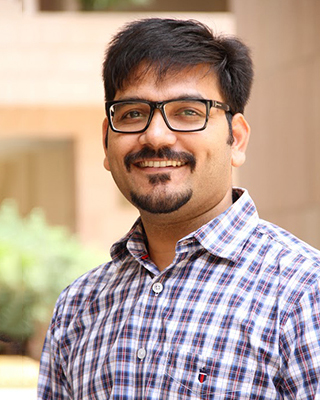
Once this interest in potential hidden biases in AI-based résumé screening was sparked, Bhatnagar continued developing the idea into a research project with Aram Bahrini, the lead faculty mentor. She was also connected to Bahrini through her work as a TA in BADM 557: Topics in Business Intelligence, an opportunity that helped create a chance for continued mentoring as the project developed into a research paper. Khandelwal (right) had guided her on the practicum and tool-development side, particularly the résumé-matching tool. Vishal Sachdev supported the effort from the MSBA/course leadership side, including encouraging student research opportunities and reviewing the work as it moved toward the final conference version. Bahrini worked closely with Bhatnagar on the research framing, experimental narrative, and resulting conference manuscript.
Bhatnagar wanted to look more into what biases may be present in the LLM. There were some biases that had already received a lot of research, such as race and gender. Bhatnagar wanted to look at other biases that might not have received much attention. She approached Sachdev and Bahrini, the faculty members leading the course, about this idea, and they agreed to mentor Bhatnagar as she developed it into a research project. She also brought in some other members of her MSBA cohort to assist with portions of the work. The team then undertook an examination of areas of biases that may have been overlooked.
For the experiment, Bhatnagar and her team created five job description categories: business/managerial, security/cloud, data/machine learning, software/developer, and marketing/writing. For those categories, they created 20 job descriptions, each with a list of required skills, experience levels, and job responsibilities. They developed five different versions of résumés for each job description, a baseline résumé and a résumé representing each of the different categories they were investigating for bias:
- Language style – modifications in tone and wording were examined for impact on the score. The hypothesis is that more polished language would receive higher relevance scores.
- Prestige markers – more or less prestigious universities or companies were evaluated in résumés. The expectation was that prestige markers would increase relevance scores, indicating a bias in favor of high-status credentials.
- Career Gaps – unexplained career gaps of one or two years were included in some résumés.
- Keyword stuffing – some résumés were purposefully padded with keywords from the job description to see how the AI system may react to that.
What the Research Revealed About Career Gaps
Bhatnagar and her team presented their results as part of the 2025 Symposium on Systems and Information Engineering Design. In their project, they showed some indications of bias for two of the parameters they were testing. Career gaps in résumés, for example, were clearly penalized by the model. Keyword stuffing also showed a significant negative impact on resumes. The other areas – language changes and prestige markers – did not have statistically significant on the scores for candidates’ resumes.
This research gives an insight into a growing aspect of business, especially for initial screening of applicants. “Major companies, especially in the US, are using or moving towards using LLM, because these kinds of tools help you give an initial level score,” said Bhatnagar.
Their results indicate that screening systems using AI may be reinforcing some hiring biases while at the same time ignoring some conventional signals of a quality applicant. This is important because these candidates, who would otherwise be considered qualified, were being eliminated from the pool before they would be evaluated by an actual person.
There are some constraints to their research. Their sample size was not large, so the scope was limited. For example, with a larger sample size, they might have been able to more fully examine the impact of career gaps – looking at perhaps gaps of one to three years versus gaps of three to five years. “Our dataset was very simple,” Bhatnagar said. “We wanted to look at a broad-level to see some patterns. And we did see that career gap was a strong, consistent thing that the LLM penalized against.”
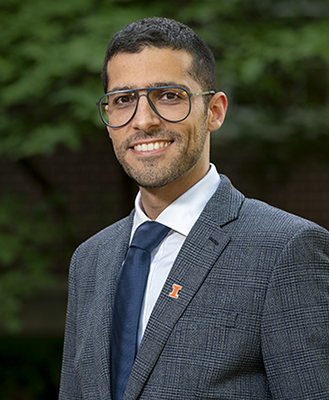
From Classroom Project to Conference Research
One unique aspect of this project was the fact that it was student driven. It developed from an interest sparked within a business master’s degree program – which is not typical for most business programs. But once Bhatnagar expressed an interest in pursuing it, the program instructors jumped in to help. “This was a faculty-mentored student research effort that developed into a conference submission,” said Bahrini, a Gies Business teaching assistant professor who was the faculty mentor for the project. “It grew organically from the MSBA practicum environment, beginning as an applied problem and then maturing into a structured research-style study.”
The strength of this project helped set it apart. “Outcomes like this are not common and not expected in master’s programs, but they can happen when a strong idea meets sustained faculty guidance and a student is motivated to build something rigorous,” Bahrini said.
Developing class projects into research is an area of growing interest for Gies Business graduate students, and Bahrini is excited to be able to help bring these interests to fruition: “We are seeing increasing interest from master’s students in developing applied work into conference-ready submissions, and I support that when the work meets the standard.”