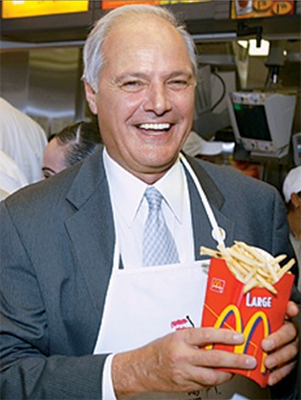
Just ten days after Gies College of Business alumnus Jim Cantalupo (ACCY ’66) came out of retirement in 2003 to lead a struggling McDonald’s as CEO, he called Mats Lederhausen with an urgent directive: Meet him in a conference room this Saturday and bring every single idea that had been squashed or ignored over the last two years.
When Lederhausen arrived, the room was stripped of corporate pretense. For hours, the two pored over dozens of stalled initiatives. As they worked, Cantalupo sorted every project into one of three piles: “Must do,” “Nice to do,” and “Don’t do.” By afternoon’s end, the path to a turnaround was clear.
"He was a remarkably decisive leader who could make quick, correct decisions and was not afraid to say definitively ‘yes’ or ‘no’ and eliminate bureaucratic delays," said Lederhausen, former president of McDonald’s business development. “In a week, he changed the direction of the entire enterprise by immediately embracing ideas that were so obviously the right thing to do.”
That Saturday session was the spark for the "Plan to Win" strategy that shifted McDonald's from a culture of "bigger" to "better." It worked with stunning speed. By 2004, the company was resurgent, reporting a 17% jump in revenues and a stock price beginning its climb from a $12 floor to an eventual $300-plus peak. But just as the turnaround was cemented – during a 2004 international franchisee convention in Orlando, Fla. – Cantalupo died suddenly of a heart attack at age 60, leaving behind his wife Rafaelita JoAnn, son Jeff, and daughter Christine.
He had saved the company, but he wouldn't be there to see the decades of prosperity that followed.
Taking the Heat
The turnaround Cantalupo orchestrated required a leader who could act as a lightning rod for the intense pressure coming from Wall Street and a restless board. By absorbing that heat himself, he gave his team the space to innovate.
"He took all the pressure off everybody else, so they were willing to take risks,” said Matt Paull, former CFO of McDonald’s. “When our reputation was at its lowest, he told us to do what we think is right – and if it doesn’t work, we’ll know we gave it our best.”
Cantalupo’s successful leadership centered on redirecting all areas of the business by adding “customers to restaurants rather than restaurants to customers.” This was a shift from fueling growth by being bigger to growth by being better, which was articulated in the “Plan to Win.” Initiatives included modernization of all restaurants, investments in modern technologies including kiosks and McCafés and, most of all, an incessant focus on store operations and Quality, Service, Cleanliness, and Value (QSC&V).
Paull recalls that while Jim was a disciplined strategist, his decisions were fueled by an intense, infectious passion for the brand. He wasn't just looking at spreadsheets; he was protecting the soul of the company. Because he stood in the gap, his team felt a level of loyalty rarely seen in the C-suite.
"I would run through a brick wall for him – and just about everybody else who worked for him closely felt the same way," said Paull. “He’s the only finance guy I ever met who had ketchup in his veins.”
The Analytical Heart
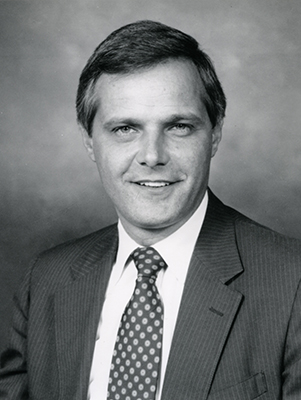
Former Accounting VP Jerry Calabrese (ACCY, FIN ’73), and fellow Gies Business alumnus, first met Cantalupo during his first stint at McDonald’s. During that era, Cantalupo grew the company’s international presence from a handful of countries to 120 markets – from Tokyo to Sydney to Moscow – making it one of the most successful global retail expansions of its time.
Calabrese says he saw firsthand how Cantalupo’s accounting degree from Gies Business provided the technical foundation for success. After passing his CPA exam, he was recruited by Arthur Young, where McDonald’s happened to be his first client. His performance was so impressive that by 1974, the company recruited him to join them as controller.
When Calabrese began working with him a year later, he assessed Cantalupo as a “numbers guy” to his core. He possessed a surgical decisiveness and an accountant’s eye for detail that fueled his steady rise throughout the corporate ranks.
“He just had the whole package. You wanted to be around him and were proud to be drawn into his circle,” said Calabrese. “He was an extremely demanding leader, but he was always fair; for Jim, it was all about accountability.”
But that Gies-born discipline was always tempered by a profound sense of mentorship. Calabrese says that Cantalupo understood that data could drive a strategy, but only people could drive a culture. He always admired how Cantalupo found ways to bridge the gap between the balance sheet and the human element.
“Jim often said, ‘Make sure people know how much you care before you show them how much you know,” said Calabrese. “If they know that you care for them, they'll always be loyal to you.'"
The Next Generation of Leaders
Cantalupo’s story ended far too soon, but his "Plan to Win" strategy became the blueprint McDonald's still follows today. His journey from an accounting student to global business icon remains the ultimate proof of what a Gies Business education can build.
Today, the James R. Cantalupo Scholarship Fund at Gies College of Business ensures that his legacy of leadership and foundational excellence continues. It was established in 2004 through an anonymous donor and, more recently, has secured more than $150,000 in additional funding from former McDonald’s colleagues, suppliers, and joint venture partners.
“By contributing to the fund, donors are doing more than honoring a memory; they are investing in the next generation of Gies students, giving them the foundation to develop Jim’s unique blend of analytical grit and heart,” said Rebecca Pagels, associate dean for advancement at Gies Business.
For more information about how to contribute to scholarships, please contact businessalumni@illinois.edu.