By Mike Koon
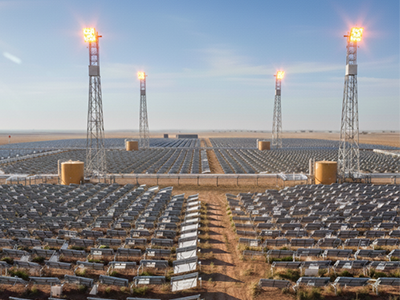
Less than a year after participating in the iVenture Accelerator as part of Cohort 11, Credence Cleantech is embarking on a pilot energy project in India. The ambitious initiative could potentially launch a cost-effective net-zero alternative for chemical, food & beverages, mining processing, and cement plants in India and beyond – and bring in $1.5 million for the startup.
The technology uses AI-controlled mirrors to track the sun and reflect sunlight into a heat-receiving tower, which then generates heat exceeding 1,000 degrees Celsius (1,832 degrees F). The heat is absorbed into a fluid and stored in insulated tanks where it can be used to produce steam or processed heat. It works much more efficiently and economically than coal or fossil fuels. Currently, industries use boilers that burn coal or natural gas to generate heat.
The iVenture Accelerator, the capstone of the Origin Ventures Office of Entrepreneurship, is a nearly two-month experience that provides University of Illinois-based startups the tools, guidance, and support to scale up their ventures. Credence Cleantech co-founder Vedang Patel (MS, Engineering/Industrial Management, 2025) says they used the iVenture experience to learn how to effectively communicate with venture capitalists, angel investors, and prospective clients.
“We learned how to showcase what we were building,” Patel said. “In just 6-8 weeks, we connected with multiple teams and learned about their journey. It prepared us for the next step in taking Credence Cleantech to the marketplace.”
Following iVenture, Patel went to California to understand the market for his specific innovation.
“We learned about technical specialties that we would need for production and developed strategies for implementation,” Patel said.
With fellow co-founders working in Germany, Canada, and the United States, the team reconvened in India to build the demo plant. Credence built its first steam-generating plant in Surat, Gujarat. They built a 15 kWth setup with 15 mirrors to generate 150 °C steam for the demo.
“If you need higher temperatures, we can increase the number of mirrors; if you need high quantities, we can increase the size of the energy-capturing area,” Patel said.
He estimates that India spends $80 billion per year on fossil fuels to generate heat. One prospective manufacturing facility spends more than $2 million a year on coal/gas. Credence Cleantech technology, by contrast, would save over 80 percent ($1.6 million) annually by integrating Credence’s solar-based system. Although Credence plans to use technology to generate electricity and clean fuels in the future, they are starting with niche market heat because there is huge demand for process heat, an untapped market & crucial to decarbonize industrial process heat to achieve net zero. About 70 percent of the total industrial energy demand is for heat, while just 30 percent is for electricity.
“Whenever we think about decarbonization and talk about net zero emissions, we need to first focus on process heat,” Patel said. “Our heat storage integration allows us to generate dispatchable energy 24/7 – behave like batteries.”
This spring, Cleantech is building its first pilot with one of India's largest petrochemical companies. If all goes well, the company could implement the technology in more than 2,000 of its plants across the country.
“Now that we are on the ground in India, having built an operational demo plant in the last 4 months, we have something to showcase,” Patel said. “As a result, the clients are really picking up. Since our technology is scalable, a successful pilot would give us entry into the market.”
“We want to prove the technology and economics first for industrial heat, then slowly scale up,” Patel said.
Simultaneously with the pilot, Credence Cleantech is raising capital, hiring employees, and planning for additional research and development.
“We wouldn’t be where we are as quickly without iVenture,” Patel said. “Not only did we learn the communication skills and practices for fundraising, how to approach clients, and what to showcase, but it also helped us build a network that we’ll take advantage of for years to come.”