By Lisa Wells
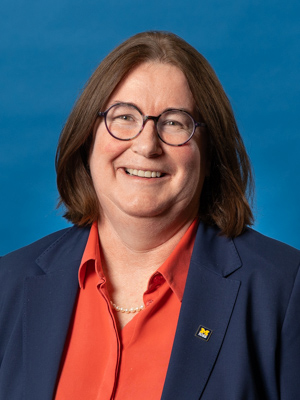
The board of trustees of the Financial Accounting Foundation (FAF) recently announced the appointment of Gies Business alumna Catherine “Cathy” Shakespeare, PhD ’02, to the Financial Accounting Standards Board (FASB).
Her five-year term, beginning July 1, 2026, marks the pinnacle of a career defined by academic rigor and a commitment to excellence in her field. As one of only seven full-time members on the board, Shakespeare will play a vital role in establishing and improving Generally Accepted Accounting Principles (GAAP) in the US. The FASB operates as an independent, private-sector organization that sets financial reporting standards for public and private companies as well as not-for-profit organizations.
“The FASB is crucial to maintaining the stability and functioning of US capital markets,” said Shakespeare. “It is an important institution and I’m deeply honored that I will have an impact on lives through the decisions I make.”
“Cathy is an exceptional scholar whose work has always bridged theory, evidence, and practice," said Michael Donohoe, Irwin Jecha Distinguished Professor in Accountancy and head of the Department of Accountancy at Gies Business. "Her selection to the FASB underscores both her individual excellence and the Department of Accountancy’s long-standing commitment to developing leaders who influence the profession at its highest levels.”
Building a research foundation at Gies Business
Shakespeare’s journey to the forefront of standard-setting began at Gies Business, where she earned her Phd in Accounting in 2002. Here she developed the technical expertise and analytical framework that have become the hallmarks of her career.
She was drawn to the doctoral program’s top-rated faculty, specifically renowned accounting professor Art Wyatt, who had previously served on the FASB.
Prior to that, Shakespeare worked at Arthur Andersen in Dublin after completing her undergraduate degree in accounting and finance from Dublin City University. She transferred to Andersen’s Chicago headquarters where she was part of a team charged with transitioning paper-intensive audit processes to technology and computer-based systems. While she enjoyed the intellectual stimulation, she felt a pull toward deeper study.
“I'm one of the people in the world who really has a passion for accounting, particularly financial accounting,” said Shakespeare. “This assignment ultimately led me to go back to school and pursue a PhD at Gies Business.”
Shakespeare’s dissertation topic emerged from a Wall Street Journal column that questioned why securitized transactions always made a gain on sale. She examined how financial instruments are represented in accounting systems long before the movie “The Big Short” immortalized how some checks and balances weren’t adding up in the lead up to the 2008 financial crisis.
“How economic phenomena are represented in the accounting system really matters for how people interpret information and then make capital allocation decisions,” said Shakespeare.
Shakespeare continued her research in this area when she joined the faculty of the Ross School of Business at the University of Michigan. There she rose to professor of accounting and the associate dean for undergraduate education.
Her research and teaching explored the complexities of fair value and how financial instruments can be sliced and diced to change the appearance of risks and rewards. This deep dive into market transparency eventually informed her long-standing service on the FASB’s Financial Accounting Standards Advisory Committee (FASAC) and its Academic Resource Group.
Eying the future of the profession
FASB Chair Richard R. Jones noted that Shakespeare’s unique blend of academic depth and practical engagement makes her a welcome addition to the board.
"I look forward to adding my talent and experience to the FASB’s deliberations," said Shakespeare. “My goals include fostering a standard-setting process that is both data-driven and responsive to the evolving needs of the global financial reporting environment.”
As she prepares for this transition, Shakespeare is also reflecting on how academia can best equip the next generation of accountants to navigate these changes, especially with the rise of AI. She believes modern accounting education must shift its focus from teaching specific rules toward developing a student’s ability to think critically and solve complex problems.
“Power skills like teamwork, leadership, and critical thinking will become more important than ever for students' future success,” she said.