Gies College of Business alumnus John Schuster, known to millions around the world as John Summit, returned to campus during Homecoming week for the first time since graduating. In a conversation moderated by Gies Business namesake Larry Gies, he talked with students before opening his arena tour in Champaign. The exchange below is quoted from the conversation, edited for clarity, and trimmed for length.
Larry Gies: "Take us back to that dorm room. Take us back to those accounting classes. Take us back to Delts. Take us back to the Red Lion. Take us back to the Canopy Club. What was that version of John Schuster at the time, and did you have any idea that this would happen?"
John Summit: "I had zero idea whatsoever. I lived in the six-pack at Hopkins. I was incredibly introverted. I never left my dorm room the first semester. I didn't rush a fraternity then. It was into the second semester when I realized I really had to get out of my room to make the college experience a real thing, and that's when I kind of really got out of my shell, met a bunch of people, got introduced to music, got introduced to the nightlife here at Red Lion and whatnot. People know me as John Summit, I guess now, but they just knew me as the campus bartender then, which is kind of funny. But yeah, I didn't start DJing until later on, and then, you know, slowly but surely built it up to where I am now."

LG: "You had a CPA. You were on track for a really comfortable, respectable career. What did you tell your mom? Like, when you got fired [from EY], what did you say to your mom?"
JS: "Yeah, I called her when I got fired. I told her I was going to be a DJ. She started crying. I started crying. It was a whole thing. But what gave them peace of mind, especially my dad, was knowing that I had a degree and had the CPA. And I just told him, ‘Let me have six, 12 months. I've made enough money in accounting the past couple of years to live off that, to pursue my dream here.’ I think I had that peace of mind knowing that I had this great career as a background. I went all in and never looked back."
LG: "But wasn't it scary to do that?"
JS: "It's the scariest thing of all time. I feel like I was just jumping in the deep end of the ocean. But putting your back against the wall like that and just being scared, I mean, that gave me so much drive. And I had all the work ethic from the school, accounting, CPA, and everything that I was able to leverage that, because I don't even know if I'm the best artist at what I do, but I know that if you combine talent and work ethic, anything is possible."
LG: "You send out 50 demos. You didn’t get a single ‘Yes.’ When did you actually believe, not hope, believe, ‘Hey, I'm going to make it. I can really do this.’?"
JS: "It was actually thousands, but that was just for one record label that I did. So that was in 2020. I made over a hundred different songs. And for the one label, I sent up to like 70 demos to them. Eventually it was my record 'Deep End' that became huge in 2020. And that's what really went viral and kind of kicked off my whole career. I was living in my parents' basement then. I just took advantage of that time because then I actually was at home by myself, fully locked in, and I made more music in that year than I have in any other."
LG: "Did you ever get close to going broke early on?”
JS: "Yes. I went full broke, and that's when I had to move in with the parents. I saved like $20,000 from the two years of accounting. That lasted exactly a year. Because I thought I was going to make money, like I was making upwards of $750 a DJ set. I was like, ‘Oh awesome, I'm playing in San Diego for $750.’ But then I didn't realize it was an all-in fee. So when I had to get hotels, food, travel, then that's when I really started getting into the accounting of the music business."
LG: “How much did the accounting [background] help?"
JS: "Big time, because I can actually audit my own financials and be able to see the revenue and expenses. I think literally I might be like the only artist that knows the difference between gross and net. And so even just having my management and agents on nets, that means that if I lose on a show, they'll lose as well. But artists famously will be losing money on other shows while everyone else is making money. It doesn't make any sense."
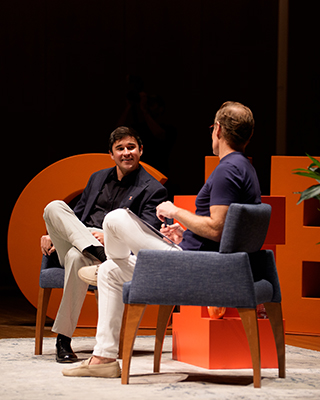
LG: "You're running a business. You're an entrepreneur. There is so much more to what you're doing. 150 people on this tour. How much time do you spend on the innovative, creative John Summit? How much time are you the entrepreneur John Summit?"
JS: "So business hours are pretty much up to 5 pm for me. So that's when I'm doing all the Zoom calls and meeting with the team and aligning on the business, the financials, everything, hiring, coaching. And then from there, then I put my phone on Do Not Disturb, tell everyone not to contact me. And that's when I can get creative in the studio, making the show, working on the lighting, lasers, visuals, and of course, all the music. If I get complacent, it's a lot of other people's jobs on the line too. So it's a lot of pressure."
LG: "How do you lead? Talk about your team and how you lead and do you have a role model for that. Everyone in [the audience] is either a leader now or will be a leader."
JS: "I think I lead through inspiration and hard work and being very present and really attentive to all the details. But then also just having amazing other leaders on the team too. We have great management, great agents, and it can't just be one person doing it. So I think just really teamwork in general, I think that kind of really inspires people."
LG: "When the production starts to get commoditized, what's the part of John Summit that will always be there?”
JS: "Well, I think people can tell when a record is made by me and they can tell the human touch. Just like when you're watching a movie, like a Tarantino film, I think people can notice that signature. I always work with vocalist songwriters, so it's clearly a human-made record. I think the more AI gets in the arts, more people lean towards human-made things. So I'm personally not worried about it at all. And I do use it as a tool in some sense for music, but not in terms of generating actual songs."
LG: "Does the creativity come to you and you’ve just got to go? Or is it one of those things that you set yourself up so you can be creative?”
JS: "The writing [usually] comes in the middle of the day. I don't think a single song I've done and written has come from, like, a huge spark. You just gotta be, like, laying down ideas. I mean, I have this thing where every 30 minutes I have a timer and then I write a song up until then. Timer ends and I start another one. Timer ends, I start another one, and then like a couple days later I look back and see what's actually good."
LG: “Do you need someone else to hear it, or do you know when you’ve got something good?”
JS: "I don't trust other people to [judge it]. I think I intuitively know. I mean, if you show it to like friends or whoever, they're gonna be like 'This is sick,' and I'm like 'No, this sucks.' But luckily, as a DJ, though I can get the crowd response. Like tomorrow I'm gonna premiere like three new records, and I don't announce it on the mic, but then I can just see the response."
LG: "You seem super open. Have you always been open?"
JS: "I mean, my first interview I said I quit my accounting job, and then eventually I got open enough to say I got fired, and then so I've always been open to a degree. When I first started DJing, I never talked about going to business school or being an accountant. So I kept that under wraps because I was like, damn, this might not look cool. Maybe they won't accept me in this space. But then actually, then I realized that it differentiated me. I think actually leaning into yourself and owning who you are and being as authentic as possible ended up paying off in the long run."
LG: "It's Homecoming week at the University of Illinois. You're back for the first time. You're performing tomorrow. It's the start of your big tour. What does this mean to you, coming back to Champaign-Urbana and starting the tour?"
JS: "I mean, this album tour is all about my whole life journey and career journey to where I am now. Truly started here in Champaign, Illinois. My first time I ever DJ'd, first time ever released music. So to kick it off here is kind of like such a full-circle moment. It's hard to explain. And the fact that it's during Homecoming week is insane for me. So this worked out so well, and I'm just so happy you guys are all here right now."